
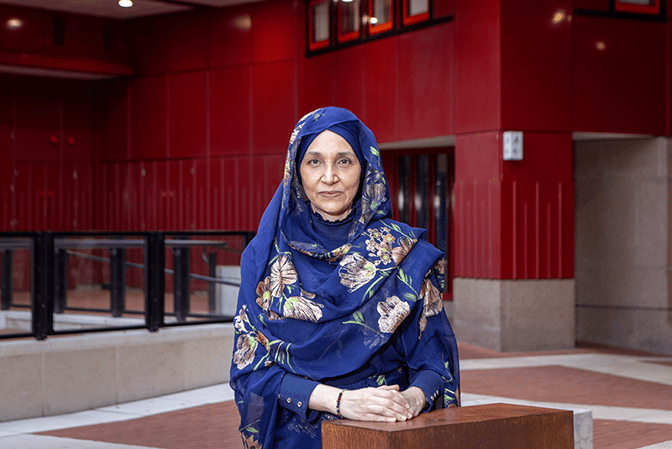
Leila Aboulela’s PEN Pinter Prize 2025 speech.
PEN Transmissions is English PEN’s magazine for international and translated voices. PEN’s members are the backbone of our work, helping us to support international literature, campaign for writers at risk, and advocate for the freedom to write and read. If you are able, please consider becoming an English PEN member and joining our community of over 1,000 readers and writers. Join now.
This speech was delivered at the PEN Pinter Prize ceremony at the British Library on 10 October 2025.
~
I thank you, members of English PEN and members of the jury, for I am honoured to win a prize established in memory of Harold Pinter, a great writer who continues to inspire so much loyalty and consistent high regard. My sincere thanks to Lady Antonia Fraser. I am grateful to the PEN Pinter Prize judges – the Chair of English PEN, Ruth Borthwick, poet and author Mona Arshi, and novelist Nadifa Mohamed. Thank you to Margaret Busby, the President of English PEN, Daniel Gorman, Director of English PEN, and all those who are responsible for me standing here today.
Lately, I’ve been watching, on social media, attempts to fix the damage that the war has inflicted on Khartoum, where I grew up. I watch student volunteers clearing up rubble in devastated hospitals, schools and universities. In the subdued marketplace, bananas are piled up for sale. Fifty years ago, I was with my father when he bought bananas from this very same market, and I remember the seller bragging that they were as sweet as custard.
Bookshops have reopened and I follow a little girl in neat, tight braids hurrying along on her first day of school. But the war is not over, the city is still almost deserted, and the fighting continues. For over two years the war in Sudan has caused immense suffering and death, massive numbers displaced and maimed; there is famine and disease. War is so humiliating. How we react when a loaded gun is pointed at us. How terrified we are when the bombs drop – afraid to shower, afraid to leave the house, too shaken to make sound decisions. How mean and small war makes us, all the shameful things we say and do to save ourselves and then the shattered dreams, the disrupted livelihoods, the shrunken futures.
Peace is infinitely better than war, but history teaches us that wars are inevitable, and conflict is part of life. It is also true that Sudan, because of its diversity and sprawl, has always been an administrative challenge. But there are ethics in war, laws and ancient conventions, to protect the weak and the elderly, to safeguard places of worship and crops – and these laws have been broken time and again. Hospitals bombed, children targeted, civilians intimidated and robbed, women raped and made homeless. Who is accountable for these war crimes? Who will be punished for the genocides in Sudan and Gaza? Who has the authority to do this? Young people are now marching for justice. Justice for Palestine and Sudan. Without justice, the balance of the world is undone. Justice is the gravity keeping us upright as humans.
I am in awe of all those who are striving for justice. The Palestinian journalists who have already died and those who continue risking their lives and being killed reporting on the genocide in Gaze. They are reporting in the most difficult circumstances, upholding high professional standards in extreme conditions. Their work is so valuable not only because they are exposing, with urgency, what is happening now but also because they are bearing witness and providing primary sources for the historical record. There are also Sudanese writers who remained in Sudan during the war, choosing not to flee so as to protect their personal libraries. This is so moving and courageous. The memoirs of these writers will be a vital testimony to what life was like in Sudan during the war.
When I was a student at Khartoum University in the 1980s, my parents didn’t allow me to join student protests. We were living under a military dictatorship, so it is a shock, now, to see all the arrests taking place in democratic Britain. I expect that British parents will start to warn their children against activism. There was recently an article in the Observer about the hunger strike carried out by the 29-year-old Palestine activist, Teuta Hoxha. She is one of 24 prisoners who are being held on remand in relation to a raid on an Elbit Systems factory in Filton. Teuta has been on remand since November 2024 and her trial is scheduled for April 2026. That’s seventeen months in prison awaiting trial. I am mentioning Teuta because, two years ago, I had a long telephone chat with her about her writing. A dear mutual friend had asked me if I would spare some time to help an aspiring writer. Teuta sent me a sample of her work entitled ‘Gods and Podcasts’. I could tell that she had talent and that her outlook was quirky and engaging. On a WhatsApp message she wrote saying, ‘I’ve had small interest from some agents so don’t want to let that boat pass, but I am a big procrastinator.’ I lost touch with Teuta after that, and I don’t know if she is writing while she is prison. I hope she is.
~
It was a big surprise for me to win the PEN Pinter Prize, a prize associated with ‘freedom of expression’. This phrase is unfortunately linked in my mind with hurtful insults towards Islam and Muslims. Long before the word Islamophobia came into use, Edward Said noted that ‘Malicious generalisations about Islam have become the last acceptable form of denigration of foreign culture in the West; what is said about the Muslim mind, or character, or religion, or culture as a whole cannot now be said in mainstream discussions about [other groups].’ These ‘malicious generalisations’ are, unfortunately, presented as examples of freedom of expression. Too often, a general condemnation of religion and the argument that ‘nothing is sacred’ develops into a targeted attack singling Islam.
Islamophobia is an inhibitor. It undermines the ability of Muslims to define themselves, to project themselves and to be true to who they are. If we, as Muslims, are always talking back, justifying, condemning, then we are always engaging in an agenda set by someone else. If we are putting our energies into challenging stereotypes and proving our humanity, we cannot take the initiative. Islamophobia poses as a mirror that reflects the truth about Muslims, but it is inaccurate. In Harold Pinter’s words, ‘When we look into a mirror we think the image that confronts us is accurate. But move a millimetre and the image changes. We are actually looking at a never-ending range of reflections.’ The never-ending range of reflections that anti-Muslim prejudice generates are distortions; they are not the truth. As a result, young Muslims in Britain grow up ashamed of being Muslim, they try to hide, and they try to melt in, before coming to the realisation (or perhaps not) that Islam is a treasure for them to inherit. Islam is the ever-living substance that their immigrant parents carried with them with they entered Britain.
Islamophobia is the enemy of originality; it is out to put us firmly in a narrow place. An example of such narrowing is how Islam is seen as a religion that is specific to a particular race or races while identifying Christianity as a ‘world religion’. This is in complete contrast to how Islam sees itself as a universal religion for all people, with a sacred text, the Qur’an, which is a continuation of the revelations in the Torah and the Gospels. And Islam is not only about people, the Creator we worship is also worshipped by celestial bodies, living organisms and animals.
Fortunately, I have found that fiction can open conversations, rather than shut them down. I have found that by writing novels, I could invite readers to a more nuanced understanding of Islam and the religious experience. This centring of Islam in my writing was criticized by some, as ‘challenging’ and ‘likely to offend the sensibilities of its intended [secular] audience’. The assumption here is that a post-Christian, secular literature should also apply to other faith communities and other religions. If the English literary novel has a trajectory from Christian to secular, then this is expected to apply to all other religions.
Literature in English is not only Eurocentric but also Christian-centric, even though writers and readers regard it as secular or humanist. Every genre from crime to science fiction is heavy with Christian symbolism while secular literary fiction, even if it is in opposition to Christianity, is also still engaged with its ethos.
However, we must remember that, in Rehana Ahmed and Peter Morey’s words, ‘the secularisation thesis emerges through a Protestant Christian trajectory.’ There have been many successful religious novels written by Catholic novelists such as Muriel Spark, Graham Greene, Flannery O’Connor, C.S Lewis, and others. The literary canon would be so much poorer without Memento Mori, The End of the Affair, The Bridge of San Luis Ray and The Chronicles of Narnia. Recently, the work of Marilyn Robinson (though she is not a Catholic) is also a striking example.
The waning of religious faith in Europe and North America cannot be assumed to be identical in other parts of the world and within immigrant minorities in the West. Religious practice and affiliation in the Global South is higher in comparison to the secular North. Diversity in publishing still hasn’t fully taken faith into account. A more diverse literary culture would include Hinduism, Buddhism, and indigenous African religions and cosmologies. The novel with religious belief at its core might be fading in the secular North but it will go, as a New York Times article says, ‘where belief itself has gone.’
Authors operate in a publishing climate characterised by secularism, one that, as Sophie Lauwers says, ‘presupposes a very particular understanding of what counts as good ‘‘religion’’.’ This pressure to privilege secular values over a religious way of life can result in expressions of Islam in fiction that are self-conscious and reactive. The creativity needed to write plots, characters and situations that are influenced by Muslim sensibility can often be stifled or side-lined by the loud glare of headlines that speak of large-scale violence and political agendas. The intimate concerns and lives of Muslim fictional characters can then seem only relevant if they are attached to the larger popular narrative.
The challenge I face writing novels animated by religious belief and intended for the secular marketplace, is best articulated by Flannery O’Connor. She says, ‘The problem with the novelist who wishes to write about a man’s encounter with … God is how he shall make the experience – which is both natural and supernatural – understandable, and credible to his reader.’ How, indeed. My intention, too, has always been to soak my work unapologetically in Islamic values and the shariah. To ‘get away’ with this was to push against the boundaries of the secular literary market. Because of this, today’s recognition feels truly significant. It brings expansion and depth to the meaning of freedom of expression and whose stories get heard. I am grateful to my publishers and to my readers. I hope that readers, with or without faith, Muslims or not, will be able to find something in my work of benefit.
~
The PEN Pinter Prize is shared with a Writer of Courage, a writer who is active in defence of freedom of expression, often at great risk to their own safety and liberty. It has been truly heartening to see the release of last year’s winner, Alaa Abd el-Fattah. Congratulations to Alaa and to his inspiring family.
It is a pleasure to share my prize today with a writer I have admired and read avidly over the years. She is a principled writer and a fearless activist, who has endured hate speech and physical threats. She is a wonderful, enriching writer who has already broken new ground in African literature in terms of language and representations of the collective, family life. Reading her work has opened my eyes to the injustices and consequences of war in Sudan. About the war, she has recently said, ‘As a writer, I have been and remain consumed by this blood-soaked history. I could never escape seeing the war’s sweeping panorama, which I describe as a map of violence in motion, claiming new territories with each turn.’
It is my honour to announce that the PEN Pinter Prize Writer of Courage 2025 is Stella Gaitano.
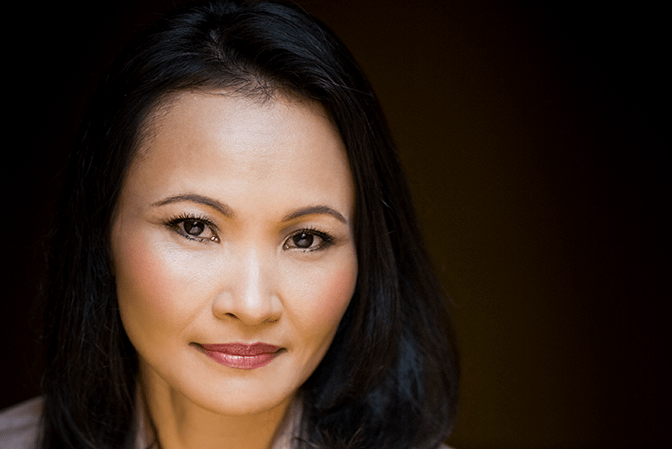
Leila Aboulela grew up in Khartoum and has been living in Aberdeen since 1990. She is the author of six novels among them River Spirit, The Translator, Minaret and Lyrics Alley, Fiction Winner of the Scottish Book Awards. Leila was the first ever winner of the Caine Prize for African Writing and her story collection, Elsewhere, Home won the Saltire Fiction Book of the Year Award. Her books have been translated into fifteen languages, and she has also written numerous plays for BBC Radio. She is Honorary Professor of the WORD center at the University of Aberdeen and a Fellow of the Royal Society of Literature.
Photo credit: George Torode
 PEN Transmissions