
pentransmissions
-
Nowhere in fiction does the found family, or family of choice, exist in such abundance as it does in superhero narratives.
-

In this issue of PEN Transmissions, we explore different types of family, different ways of building community.
-

I wished I could explain what had happened since we had last met. How people were rounded up late at night and how at sunrise, it looked as though nothing had happened. How dad was imprisoned for his journalism, shot at, exiled to Germany.
-

She just doesn’t like the idea of metamorphosis. It terrifies her to picture that some unforeseeable change could take place in her body abruptly and she’d wake up a foreign object.
-
You may think of Kafka; you may think of Ovid; you may think of Transformers, of cars turning into terrifying robots.
-
If this were a novel, the writer might have preferred an epiphany to occur right here; but in reality, it took some more time to realise how I had changed in the four seasons I had been away.
-

The capacity to imagine has always been the driving force behind feminism; a radical, stubborn, luminous imagination which has allowed women, again and again, to move beyond the narrow confines of the possible.
-
Recently I have begun to wonder to what extent we conceal a more mundane reality when we assign ideological narratives to these extremists: that of cowardice or an inability to confront male inadequacy.
-

Your private self is other: you don’t have the intellectual capacity to keep track of it all. Some days you give away more about yourself than you had intended to: you’re untidy, indecently exposed. Sometimes others seem to know more about you than you do.
-
As the days are getting shorter, we investigate things that are tucked away in dark corners of the brain – or the national consciousness.
-

‘This novel is structured around the relationship between silence and speaking. Silence is the major hero. People who have gone through terrible trauma don’t want to remember. It all needed time to come out, and now things are coming out.’
-
‘People will fight another to assert the truth of their story. Novels tell us that in fact there isn’t one story. Everybody has a piece of a true story. It is like the story of the blind people and the elephant.’
-
In 2017 I needed reasons to stay alive. My family and friends wrapped their arms around me but they couldn’t always be there. But I had the gentle pace of baseball, the at-bat tactics to focus my mind.
-
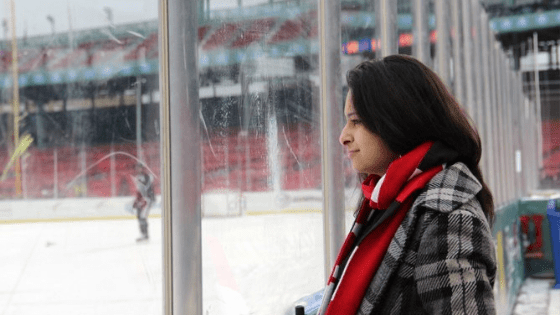
Barely a month after I was sexually assaulted, I stood in the ice hockey rink at a small prep school. The holiday tournaments were taking place and I’d foolishly agreed to go. It was too soon for me to be there, that much I knew.
-
Sport is emblematic of what goes on in society as a whole. In this issue of PEN Transmissions, we’ve looked at it as a method of inclusion – and exclusion. As a method of belonging as well as of extreme alienation.
-
Money, power and politics are inherent to sporting events, yet the veil of economic progress, entertainment and sporting frenzy only serves to cover up a far darker reality: in Bahrain, prisons are filled with those who dare voice their opinions.
-
Mum and I were very different. We shared a body at one time (though it would be more accurate to say I invaded her), but she didn’t think we had much in common. From what she saw, I was slow and uncoordinated.
-
In this imagining of yourself you speak English and it is 2018 and you identify as female. The world seems to be caving in around you, almost apocalyptic. You begin to notice words more than you have done before.
-
I should say at the outset that being a product of my surroundings, I am not particularly in tune with the natural world. I have always lived in extremely built-up cities where I can get everywhere on foot or by public transport. I grew up in Singapore.
-
I never consciously make a decision about what to say in a poem: the poem itself says itself. So the poem happens. It doesn’t happen because I have decided that it should happen. It wasn’t a conscious decision to write about nature. The nature just bubbled out.
 PEN Transmissions