
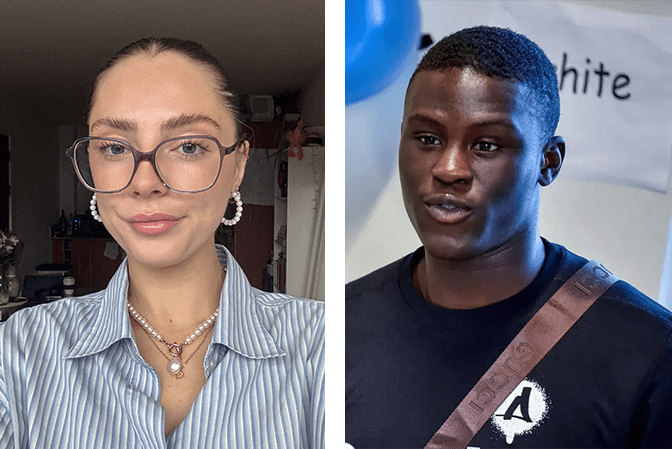
Hannah Branston and Ade Adedeji on art and activism.
PEN Transmissions is English PEN’s magazine for international and translated voices. PEN’s members are the backbone of our work, helping us to support international literature, campaign for writers at risk, and advocate for the freedom to write and read. If you are able, please consider becoming an English PEN member and joining our community of over 1,000 readers and writers. Join now.
HANNAH BRANSTON: Hi Ade, it’s great to speak with you. I’d like firstly to know whether you consider yourself to be a ‘creative’ and, if so, when you first recognised yourself as a creative person?
ADE ADEDEJI: I think I’ve always seen myself as a creative. Even from a young age, I liked drawing and had always been good at creating stories. But I just didn’t see the potential until high school, when I started tapping into my creative side and I decided to create a book called Something to Say.
It was more like a magazine. It had photography and poetry from black people who grow up in my areas; stories about what they have achieved in their lives. There were contributions from a footballer, and a black female boxer, and a bit of my story too.
I’ve heard about this magazine – it sounds like a great, multi-layered concept. I think creative expression is an incredible way to both build and unify cultures and communities. I’d love to read it.
I would consider myself a creative too. Similarly, from a young age, I enjoyed consuming and creating art. I found it a good way to deal with difficulties in my life – especially short stories, which I used to navigate ‘big feelings’ and my past experiences. Over the past few years, with the time-consuming pressures of university and full-time work, I’ve been exploring drawing as a quicker form of creative expression.
You use your lived experience within your work. Would you say that your creativity has helped you to reflect on your upbringing and the things that shaped you?
1000 percent – I feel that without having the opportunity to explore my creativity, I’d have probably felt very lost. At school, my teachers always described me as a troubled child; I could never focus and would distract the other kids. Little did I know I had ADHD. In high school, that’s when I started to explore the depths of my creativity. I wrote about being a black boy in a society that doesn’t understand you. I wrote spoken word poetry, and it was exactly what I needed. I felt like my mind had opened up, that I could see and understand myself and the world way better. I wanted to create a platform for people of all races and ages to have the same feeling, which is why I created my magazine.
I’ve been working on something recently. Would you like to hear my most recent poem? I wrote about a recent killing of a young person and how it made me feel. Let me know what you think of it:
In city streets where young hearts roam,
Where laughter once had made its home,
Now sirens wail and mothers cry –
Another soul has said goodbye.
A blade once hidden, now revealed,
A wound too deep that won’t be healed.
Not just the skin, but lives it tears,
Replacing dreams with endless prayers.
A moment’s rage, a reckless choice,
And silence steals a hopeful voice.
A future lost for both involved –
One in a cell, the other’s solved.
What glory lives in blood-stained hands?
What pride in grief that never stands?
No strength is shown through acts of fear,
True courage means to persevere.
Put down the knife, choose peace instead,
Let words be spoken, not bloodshed.
Lift one another, heal the pain,
So love, not loss, is what remains.
The world needs hands to build, not break –
To hold, not harm, for justice’s sake.
Let’s change this course, reclaim our youth,
And walk a path of peace and truth.
That really moved me. You have such a powerful way with words. I’d love to see hear more of your work. And I’m so glad that art and creation have supported you where systems couldn’t. I think art is really a powerful tool to explore things that happen both directly to you and around you, within your communities, to those you know and love.
But we both know now of the risk such art can bring – predominantly to black boys and men, in that just having lyrics or poems written in your notes app can be used as evidence in criminal proceedings, leading to convictions under joint enterprise. Did you ever think or know, before your own experience with this, that art could be used as such compelling evidence for crimes?
If you did know of that risk, would you have felt like you had to censor yourself, your art, your creativity, in fear of how it may later be interpreted and criminalised, regardless of its actual inspiration?
I never knew how the system affected people, especially rap artists, until my own experience. I didn’t know until I was on trial, and they were using my co-defendants’ rap lyrics as evidence. In that moment, I began to realise like, wow, what has the world had come to. As young kids, we didn’t have the opportunities most people did. We grew up in a world where youth centres were being closed down, prisons were overcrowded, poverty was on the rise. Even now, the cost of living is crazy, and the opportunities to better yourself are limited, so as young people we find ways to express ourselves and our frustrations. For that to be used against us, in a court of law, is mad; rap lyrics are rap lyrics, just like poems are poems, like spoken word is spoken word. It angers me seeing people incarcerated for expressing their frustrations at the world.
These days, rappers have to censor themselves from speaking about certain issues, out of fear of it being used against them in the future. Art is art; art is a freedom to express ourselves and observe our life as it is now.
I absolutely agree. The arts and community resources are being continually defunded, which has detrimental impacts to younger generations. When people use creative expression to navigate their life and the world around them, this should not be used as sufficient evidence to lead to incarceration. I have seen a comparison between rap music and country music – rap, of course, being predominantly associated with black communities, and country with white. The lyrics and messages can follow similar themes – anti-police sentiments, references to murder – but across the US and UK it is rap and grime and drill music that is used as criminal evidence. It raises the question of what’s considered storytelling and what’s considered an admission of guilt, and why this appears to be so intrinsically linked with the race of the creator (or consumer) of that art.
You were seventeen when you were convicted for conspiring to commit grievous bodily harm, a conviction that was overturned at the start of this 2025. Those are fundamental years of your life. I wonder how your experience of being wrongly convicted and imprisoned affected your relationship with your own creative consumption and expression?
You know what’s funny? Recently, I have been forgetting that I was convicted, and then had my conviction overturned. That’s a really big thing: I took on the system and won, which barely ever happens. I spent my eighteenth, nineteenth, twentieth and twenty-first birthdays in prison. I missed Christmas; I missed my friends’ and family’s birthdays. For nothing.
I had so much support though. I had people I had never met sending me letters, sending love and support, telling me to keep being me. So I did exactly that, taking the time to sit with my creativity. One of my friends once told me to write a book about my life, so while I was incarcerated, I started writing it all down. It helped me acknowledge and heal my past trauma – I wrote poetry about the biases young black man face; I danced in my cell to old-school Michael Jackson. I’m glad to say that being incarcerated didn’t hinder my creativity. I was locked in my cell 23 hours a day, and I had no choice but to do what I loved. I wasn’t going to let the system take my creativity from me. They could lock me up for as long as they wanted, but in my mind – in the unlimited confines of my creativity – I was free.
I received an arts qualification while I was inside, which gave me a space to showcase my poems, writing, and drawings. I was able to share them with others who were also incarcerated.
It’s so important that there are arts courses within prisons like the one you did. They have a profound impact. Art is known to be therapeutic and beneficial in articulating and processing feelings – which makes it even more difficult to comprehend how it can be so heavily relied upon as evidence in criminal proceedings.
Before your wrongful conviction, you were set to start a law degree. It’s clear that you, within your art, criticise systemic failures and the struggles many young black boys face. I’m interested whether you would consider yourself an activist? And, if so, does activism consciously feed into your creativity or is it a subconscious factor that arises simply through your own experiences?
A lot of people say I am an activist, but to be honest I didn’t really know what that meant till recently. I think I am one at heart. From a young age I protested the wrongs of the world. Activism intentionally stimulates my creativity by directing my experiences into art and expression – but it also goes deeper by allowing me to observe more and build connection.
That last sentence sums it up perfectly. There is an intrinsic overlap between activism and art. The final question I wanted to ask you is whether you believe that experiences such as yours, and the corresponding work of campaigners such as those behind Art Not Evidence, will effect change? Do you believe that activism can truly change the status quo, or do you think the system will always be inherently discriminatory?
In the long-run, yes. I do think it will effect change because my case – and many other cases in the public eye – have brought light on some of the issues that happen in criminal trials. If you’re young and black, your art and passion and lyrics can be used to prosecute you. The system has taken away our family and friends. There needs to be a change, and I think that Art Not Evidence will be the first of many campaigns to make a difference. I believe that raising awareness and engaging in action may help to change things more broadly. Campaigners, and those like me who have been harmed by the legal system, drive discussions that push institutions to pay attention. Narratives of erroneous convictions have resulted in cases being reviewed, increased scrutiny of prosecutorial conduct, and demands to amend unjust laws. The system has long-standing biases and numerous obstacles to reform, so it won’t be possible to completely eradicate discrimination overnight. But the more voices that are heard, the more difficult it is for the system to overlook these injustices. Eventually, this pressure does change public opinion, change policy, and occasionally even change legal standards.
Hannah Branston is a young legal aid lawyer, born in Leeds and based in Manchester, completing her training under the Legal Education Foundation’s Justice First Fellowship. She has worked with charities including BLAM and volunteers with Art Not Evidence. Alongside her legal career and dedication for social justice and reform, she has a passion for both consuming and creating art and literature and explores the importance of freedom of expression throughout her work.
Ademola Adedeji is a justice advocate, public speaker, and lived-experience leader working to transform how young people are seen and treated in the criminal justice system. After being wrongly convicted in the Manchester Ten case, where creative expression was misread as criminal evidence, Ade’s conviction was overturned on appeal. His experience drives his commitment to challenge harmful narratives, promote youth empowerment, and advance fair, community-rooted justice.
 PEN Transmissions