
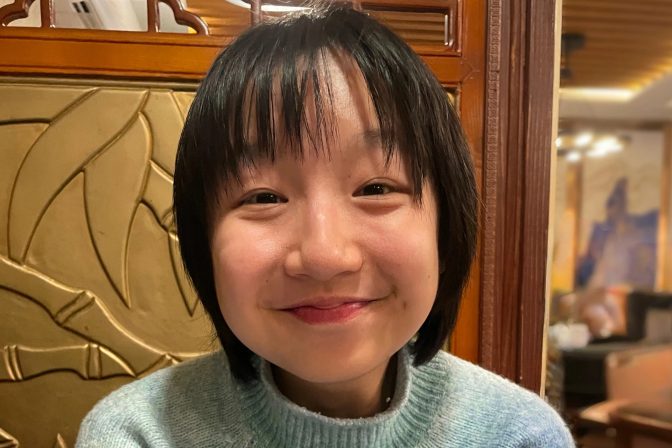
Hongyu Jasmine Zhu on precious memories with her mother.
PEN Transmissions is English PEN’s magazine for international and translated voices. PEN’s members are the backbone of our work, helping us to support international literature, campaign for writers at risk, and advocate for the freedom to write and read. If you are able, please consider becoming an English PEN member and joining our community of over 1,000 readers and writers. Join now.
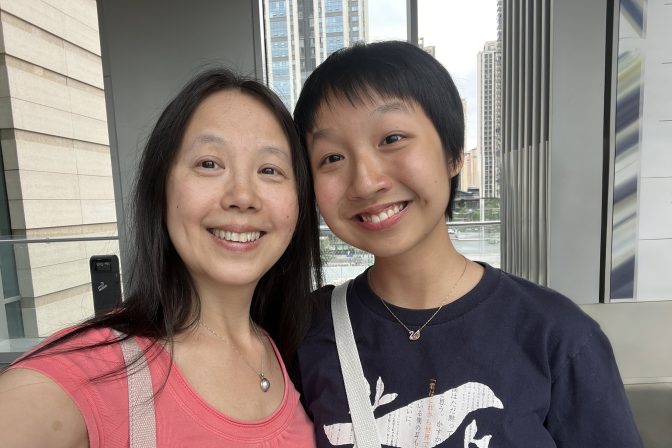
They took mama’s womb. And her voice, once so full of words that by day and night fed stories to a toddler who grew into a daughter who’d been mostly paying them no mind; of sweet music making that had taught the child to sing and be happy and clap her hands with mama while she did that.
Nineteen hours of flight can land you in a very different season. I was on an end-of-semester trip in California, dumping photos of myself in the family group chat, chasing sunny waves with a goofy smile. Then I was on a subway train from Chengdu Tianfu International Airport to Sichuan Provincial People’s Hospital. I had already grown used to, even a little fond of, Chengdu’s smoggy skies. But when I stepped out into winter on 28 December 2023, I was hoping to see beyond my next few steps.
For three days after mama’s big surgery – or ‘transabdominal cytoreductive surgery’, as I would later learn to pronounce, making photocopies of the operative report – she was lying flat on her hospital bed. To even stir a muscle on her face was too much pain. But we chatted away anyway, like we always did, only this time there was only my voice.
‘Mami, what season are you? I’ll give you options, one by one. When you hear the correct answer, tell me by wrinkling your nose.’
I must have sounded proud and pleased to have invented a new language for us. A body language.
She must have tried to wrinkle her nose; I saw her nostrils flare a little. Mama seemed just as excited about the game as I was. She stared at me with her effortlessly big eyes for a good while, as if she couldn’t wait for me to give her options.
‘Okay, maybe instead of wrinkling your nose, you blink your eyes twice.’
She closed her eyes, opened them, then did it all over again. Blink. Blink.
‘Are you summer?’
She remained still, and I watched the drip chamber keeping time.
‘Are you autumn?’
In the corner of the ward, baba was dozing off in our designated chair. A chair that had been turned into a clothes hanger, a bedside table, and – whenever a nurse’s footsteps drew near – a makeshift storage, so we wouldn’t get scolded again for cluttering the windowsill with all that paraphernalia hauled along ‘just in case’. For baba, though, the chair had remained a chair, a place to snuggle in among Leslie Cheung’s old CDs, a stackable lunch box half-filled with chicken soup, a few extra pillowcases, and the Japanese textbook I had left open. Since the orderly began sweeping the floor and another morning arrived, baba had been at mama’s bedside. Only when she managed to briefly fall asleep would he run up and down the buildings, propelling one determined foot before the other. On his way to chase signatures, prescriptions, a sliver of the doctors’ attention, baba swung his arms up and down. Going for more steps, more hopes. Between when I spoke and was about to speak again, I heard him snore a little louder.
‘Are you winter?’
Across the windowpane, the sky was a fish-belly white. I didn’t like this option, though I felt that I had to give it, so I moved on without waiting for an answer.
‘Are you spring?’
She immediately closed her eyes, opened them, then did it all over again. Blink. Blink. This moment she had been waiting for.
‘Okay! So you’re spring! Now’s my turn. What season am I?’
I saw something in her eye twinkle. Was this the moment where she thought, Piggy’s still such a little kid, as I would later read in the hospital diary she was keeping?
‘Am I spring?’
Catching a slight movement of her head which I translated as a nod, I continued: ‘Oh! So, I’m spring too?’
I didn’t know that this would move her head left to right, then right to left; so much effort involved, the most I’d seen since the surgery. I got a little confused: ‘You mean we’re both spring?’
Then I heard her try to utter what sounded like no, no, no, reaching for breath. I sensed something in my chest begin to tighten as her brows knotted together. I worried about the postoperative wound on her belly, how much it was hurting, if her pink abdominal binder that had tender flowers on it was still in place. I couldn’t help myself from stealing a nervous glance at the digits on the bedside pulse oximeters.
‘I see, I see, I’m not spring!’
And that made her rest.
‘Am I summer?’
Yes, she responded, moving her head up and down, this time without the previous urgency with which she’d denied my claim of spring. Yes, summer, she let me know by moving her head up and down. I’d like to think I saw a smile on her face, although it was still impossible to stir a muscle. Yes, I heard her body speak to me. All the while, her eyes were closed. I can’t tell how much of it was because she was just too tired from our conversation, and how much was her relief, happy that I finally understood what I was to her.
It helped that I had just got back from my Universal Studios trip in California, so I had many things to tell her, full of unimportant details I could still recall, the odd bits that I knew would send a hearty giggle up her throat. I told her many things. Mama blinked her eyes, this new way of hers to let me know she was listening. When I walked around her bed with my arms and legs straight like Megatron’s, I saw the left corner of her lip make a small upward climb, and I heard the laughter ring out in a wrinkle near her right eye.
I was eager to fill in the gap of sounds between us. But sometimes, even blink blink became too much for her to keep up. When the oxygen tube fell out of place, or her eyes, curiously wandering all four corners of the room, began to lose focus, I’d learned to rest my hand over hers. It was my way of telling her that I was listening too. Feeling her hand, small and soft beneath my fingers, which couldn’t decide what would be more soothing for the little red swelling where the peripheral IV lines entered her body – to circle gently around it, or to leave it untouched – I remembered another time when our hands were touching.
It was two years ago when mama flew all the way from home to the States to spend the school break with me. I was still a high school student then; we visited a bunch of colleges. New England summer was just as humid as Chengdu’s, but more generous in affording a cool breeze in the shade. And trees were many. Mama would be walking by my side and naturally reaching out her hand to hold my hand, finding an opportune moment to slip her fingers through mine, so that I’d suddenly find them interlaced. As much as I took pride in having whispered secrets to mama – cuddling under the same blanket, in the intimate late-night-ness of our hotel room, illuminated by faint streetlights – I wasn’t used to this body language in the open summer light. My sweaty hands, which had always made me feel embarrassed, I was happy to have this time. Saying how my hand was so sticky that I needed to wipe it against the side of my shirt, or pointing for her to look at the storefront of a cafe that promised delicious cakes and cozy chats, I’d pull my hand away from her hand. I never found out if she had seen through my tricks. Was this too part of her summer – me, and us holding hands together?
~
It is the last day of February, once more. I tuck my hands into the pockets of my coat, the first coat I bought without mama on the side as my fashion consultant, and start walking up College Hill. Mama was once here, too, in a summertime. Tall branches, having bloomed snowy-white against the wind, stand lean and bare in the afternoon light. In the hand now balling up for a little extra warmth, is it the tender of her palm that’s touching my fingertips?
I had imagined today many times, since February 29 became mama’s day of leaving. I had been afraid of looking for a twenty-ninth day and not finding one. But then I remember mama, you looking for a day to come home and finding many – didn’t you say you’re spring? There will be many days of spring. You close your eyes, open them, then do it all over again. Yes, you say, and you’ll be here, fingers interlaced with mine. This time, I won’t let go, walking into the seasons, through many more. Blink. Blink.
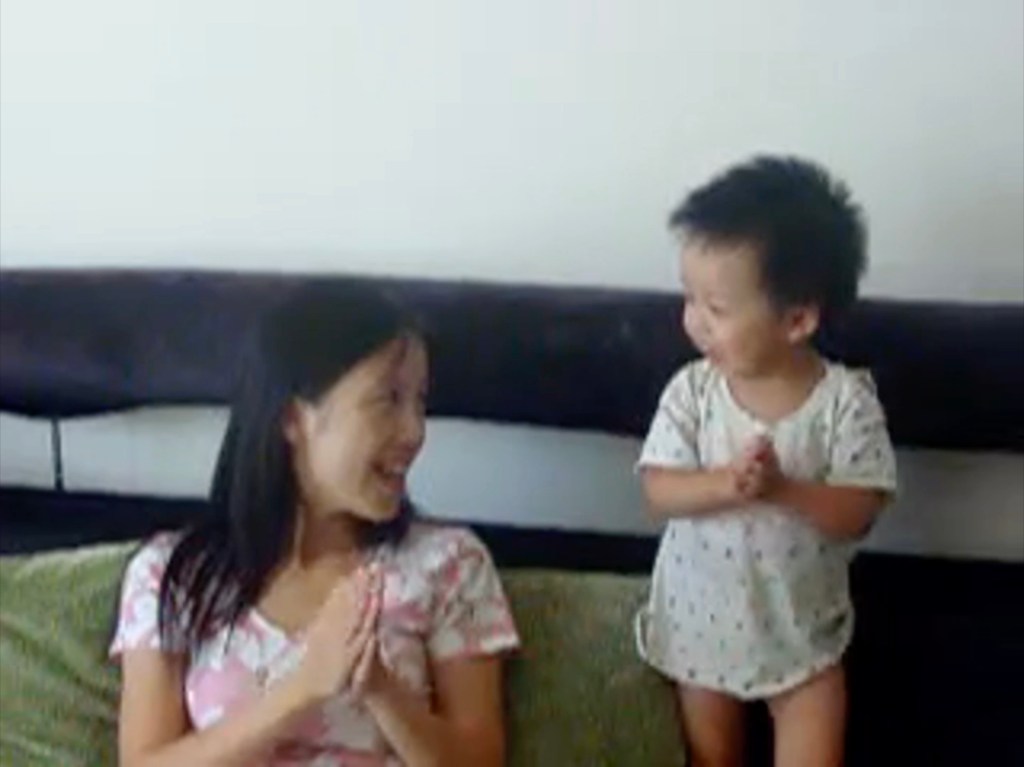
In loving memory of 曾继红 Bonita Jihong Zeng (19 October 1972 – 29 February 2024), her big voice in songs and jiggles, and every morning.
Hongyu Jasmine Zhu 朱弘昱 calls Chengdu home. She is exploring creative possibilities of grief work and looks forward to sharing a few reflections as a TEDx speaker. Hongyu is Editor-at-Large for China at Asymptote Journal and studies literature at Brown University. Her translation of Zhou Jianxin’s Little Squirrel and Old Banyan passes goodbyes and forevers from branch to branch. Jasmine has received support from Bread Loaf Translators’ Conference, Frontline Creative Non-Fiction Fellowship, Los Angeles Review of Books (LARB), and elsewhere. She reviews children’s literature on Words Without Borders and World Kid Lit, hoping to one day open a reading room where no one is too young or too old to huddle and play.
Headshot photo credit: Ruixiang Li
In piece photo credits: Bonita Jihong Zeng and Yuehai Zhu
 PEN Transmissions