
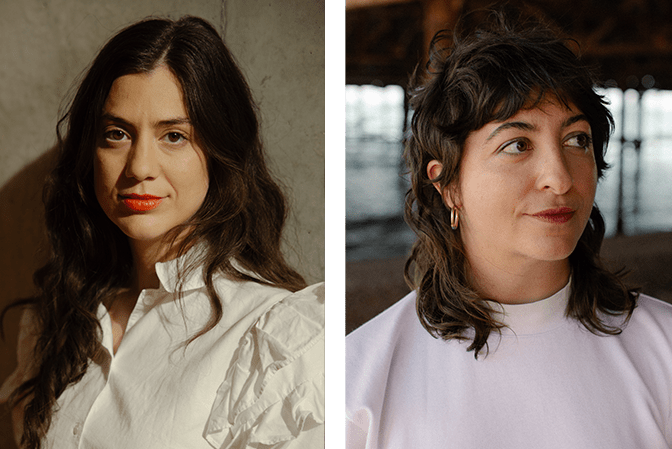
Michelle Steinbeck and Jen Calleja on fascism, femicide, and ghosts.
PEN Transmissions is English PEN’s magazine for international and translated voices. PEN’s members are the backbone of our work, helping us to support international literature, campaign for writers at risk, and advocate for the freedom to write and read. If you are able, please consider becoming an English PEN member and joining our community of over 1,000 readers and writers. Join now.
Michelle, Jen – thanks so much for speaking with me. I was lucky to get to read Favorita right at the end of last year, which meant that when people asked me about my favourite books of 2025, I got to include it. I thought it was mesmerising and gentle and vicious and slippery and clear – and a masterpiece.
I’d like to start with a question for you both. In part, this is a book about seeking: seeking truth, seeking revenge, seeking purpose, seeking connection, seeking forgiveness, seeking sisterhood. What else do you both think it seeks? And what do you think it finds?
MICHELLE STEINBECK: Oh thank you! I think Fila, the narrator, also seeks to get to know her mother after her death – an of course impossible endeavour. And she finds that private matters that were hidden in her family because they were seen as ‘shameful’ – like having an illegitimate child, or being sexualised in public as a girl, or her mother working in the sex industry, or even the violent death of her mother – are not so private and singular at all. In that, she finds a lot of what you mention. She also finds resistance. And ghosts and friendships – and quite some action.
JEN CALLEJA: I was thinking throughout the process of translating Favorita that the novel is also ‘about’ seeking to create new ways of exploring the intersection of a variety of injustices through a story while revealing what happens when we make real lives and real events into stories. It does this through its blending of genres, its form and structure, its surreal nature. It’s also what I found so incredible about Michelle’s first novel, My Father Was a Man on Land and a Whale in the Water, which I also translated; these set pieces which seem so simple and even whimsical, yet get to a deeper and more nuanced truth than straight-up realist fiction.
One way of describing Favorita is as an intergenerational matrilineal story. But it’s one where only one generation still lives – where we have that story told singularly through Fila’s voice, and she has it told collectively by Magdalena and Lavinia and the women who encounter her and them. The epigraphs to the book are by two writers, Goliarda Sapienza and Johanne Lykke Holm, who are deeply interested in death, ghosts, haunting, and their gendering. Could you both talk to me about ghosts?
MS: Writing this book, I was in a similar position as Fila: I wanted to know more about her family history and about the lives of the murdered women. But how could I write about all of it if I knew so little? Could I just imagine, pretend, claim? Would their ghosts haunt me if I wrote such lies – or if I wrote something true but unknowingly? The working subtitle of the novel was ‘a necromancy’; it was what we were doing, my narrator and I, to find out more about the dead women, trying to hear their voices, instead of all the people who talked about them after their death.
I started researching and writing this book in a supposedly very haunted place – an old Villa in the woods, where many people reported to have seen or felt the ghost of the murdered woman I was writing about. It was the perfect place to get obsessed. In the daytime I wandered in the woods with my portable typewriter. At night I couldn’t turn off the light.
JC: I thought about the women in my own family constantly while working on Michelle’s book. I thought about my Irish grandmother, my Maltese grandmother, my own mother, all of whom are no longer here. I didn’t really know any of them very well, apart from the fact that they too had difficult lives due to the expectations placed upon them, so translating the book was a way of being with them, alongside them.
I’m not the first translator to say that translation can feel like a seance. There are all these voices and references at play in the text, and then you channel them like a medium – what do you hear, what do you mishear?
About halfway through the book, the form changes and we read fictionalised newspaper reports about the murder of Sisina – who becomes integral to the story – and the subsequent legal proceedings and community fallout that occurs. I thought they would last for a few pages; they last for many, many more. I was so glad that they did.
Michelle – could you talk a little about this section? How far into the writing process did the decision to use this form come to you? And why? And why do we read these 30 articles uninterrupted by narrative voice?
Jen – could you talk a little about translating this section? It’s such a different voice to Fila’s, but it’s at once so in the voice of the book – of Fila reading it, somehow. It feels pitch-perfect both in representing reportage of its era and in implicitly satirising it. Michelle’s afterword talks about source for writing these; were there particular touchstones for you in translating it?
MS: I’m glad you’re glad! It felt like a bold move. I was worried readers would have a hard time sticking with it and would just turn the pages or, worse, stop reading at all and put the book away. I tried to make it shorter too – or rather I planned to. But in the end I needed it all. And I hoped at least some readers would find it as thrilling and revealing as I did.
I wanted a reader to have the same experience I had when I was handed the book about the real case on which Sisina’s is built. The excitement, the cosy shivers, the strange interest in all those details. This true crime feeling: maybe I can solve the case? And then the disgust creeping in, the feeling of a void: why would I be excited about this? What’s wrong with us, that we feel murdered girls are some kind of entertainment? This was a major concern while creating the book: how to write about the violence without reproducing it. I felt I needed to show this reproduction which happens, for example, in the media – and which shockingly hasn’t changed much since then.
By giving Fila and the reader these newspaper articles, I also wanted to open a room for reflection about how society wrongs the victims of femicide and patriarchal violence. Before we come back to Fila’s voice and her commenting.
JC: I think what you say about this section is right. That it still has the style of the book running through it, and that it feels like Fila is still present while you’re reading it. It’s not a complete dropping out of what has come before; if anything, what surrounds it shows the absurdity and surreal nature of the ‘real’ events.
I asked Michelle if the articles were all from the same newspaper because I initially tried to make them seem consistent. But she clarified that they’re from a range of newspapers, so I then had different ‘rules’ where some would sound more tabloid and others more broadsheet (these are obviously UK distinctions, but these are what I could reach for as references – newspapers in different countries have different styles and voices). I didn’t use Michelle’s source as the book is in Italian and I don’t speak Italian!
Jen – you’ve worked with Michelle before. How has that affected your craft?
JC: The first experience of working with Michelle in Rome while she was on a residency there made me rethink – or at least complicate – the reasons why I translate. We became very close through the intensity and vulnerability we were both open to when working on the first book. The translation became this apparatus for becoming close with another person.
I started thinking: a translation might just be the record of a time of collaborating closely with someone and becoming their friend. We subsequently worked together on Favorita for a week in Switzerland, but we’ve also had a holiday together in Paris where we kept talking about working on a translation but ended up just having a nice time together instead. Maybe the translated text is beside the point in one respect – though in other respects, it’s obviously very important!
Michelle – you’ve worked with Jen before. How has that affected your craft?
MS: I started translating only after I met Jen, so it’s fair (hehe) to say our working together woke my interest in translating. And when I do, I use what I know as her technique: leaving alternatives for particular words in the first versions. It was so interesting and fun to see how she did it with my novels, to witness it being written again and to see those decisions on paper, decisions which otherwise happen in the unseen. After all, writing is deciding. Every single word is a decision. We discussed the nuances between these words, which after the dictionary mean the same thing but are not exactly the same. And by doing so I not only learned many lovely British expressions but I had to think about my choices of words and why I had picked them. Last but not least, I became more aware of writing my characters with the respect they deserve. And that’s thanks to Jen.
To take that further: how do you work together? Or, to put it another way: Jen, in your searingly sharp book Fair: The Life-Art of Translation (whose lines have in ways inflected how I think about my work on English PEN’s translation projects), there is a passage in which (bear with me on the framings here), you recount watching a video of you and Michelle reading translations of each other’s poetry and texts about meeting each other, and where you quote one in which Michelle talks about a dinner together in which you eat pasta with urchins, maybe leeches, after which your narrative voice, Jen, then notes “We call each other Urch and Leech, interchangeably.” So, when it comes to Favorita, who is an urchin and who is a leech?
MS: The pasta was spaghetti ai ricci di mare, sea urchin. Me ordering it was a total impostor move; the waiter even asked ‘Are you sure? Do you know what it is?’ and I said ‘Of course!’ But I’d never tried it, and I really did not like it when it arrived. The poor urchins looked like little blood clots or leeches. Is this a symbol of our reckless way of translating? Ha. In any case, I’d say our friendship grew with us daring each other to eat them. It was Jen who taught me about impostor syndrome. That was enlightening, and helped me to understand and navigate through writing crises. So who is whom? I couldn’t say. They’re the same but different.
JC: I’m glad you enjoyed Fair! I write about this time in Rome with Michelle in a long essay called ‘Miracle’ which was published in the anthology On Relationships (3 of Cups), and in Fair I have Michelle recount the story in her own words, which she self-translates from German into English and which I include verbatim. This is for important reasons.
I recently read out this section from Fair – Michelle self-translating this dinner experience – at a reading and those listening were really moved by it, they laughed and ahhhh’d, so Michelle’s translation worked, it connected with people, even if not in ‘perfect’, ‘literary’ English. My approach as a literary translator into English is to recreate a work of German-language literature into a work of English-language literature as if I’m a storyteller who has travelled from Switzerland where I heard this story and passed it on to others back in the UK. But what about a ‘good enough’ translation, one that gets across the story?
We are interchangeably ‘urch’ and ‘leech’ because it’s more about that shared experience than nicknames per se, but, going back to the first part of your question, it perhaps says something about our way of working, which is breaking the typical author-translator binary to create something that feels very collaborative, even by getting invited to give some feedback while the original of Favorita was still being edited. We’re urch and leech equally.
Michelle – there are moments when images and vistas and places rush to Fila: ‘Candle flames heat my cheeks. Images flicker in the gleaming glow.’ As she follows the strange path that the act of seeking takes her on, she arrives in extraordinary places and sees extraordinary images. So, therefore, do we readers. And the further I went, the more I felt like I was seeing images from previous pages flicker in the glow of reading, too. My question: how did you build the spaces of the novel – the old salami factory, the villa in the forest, the places around them – and the figures and landscapes and hauntings that make them? How ‘real’ are they?
MS: So real! Many people say how dream-like or nightmarish the book is, and I smile and nod, but inside I’m like: but it’s all real. Of course you can’t say that as a writer. Instead I say, nothing is real in writing, it’s all just words, and every word is real too, so everything is real.
To stick to your examples: The former salami factory really – and quite miraculously still – exists; it’s mentioned in the afterword too. It is a beautiful resisting place on the periphery of Rome, with people – many families and children – who built this inhospitable place into their home. A big squat that shields itself from the danger of being cleared out by being a museum. Famous artists have painted the walls. And they do have a moon rocket.
And the villa in the woods, yes, there is a place like that. It’s where this novel started. There was a murder in the late 1940s and the young woman that was killed is still very present. And there is a ghost town nearby with just one woman living there – with many cats. And people are telling wild stories about her.
What other dream-like places are there? The ships, for example – the fascist bathing colonies that look like ships – they’re real too. Or the cellar in the church with the skulls. That’s in Naples; it’s all real. And my Italian grandmother really did have a mortadella-coloured telephone.
I think I’m right that that no dates appear in the book, but we’re clearly at points somewhere after the Second World War and at points somewhere near today. These times share fascism, femicide and violence (in fact and in discourse and in soul). Authoritarianism always comes early for art, and is always embedded in (and embeds) gendered violence. Two lines from the same page come to me: ‘Even my mother, the loudest of them all, was silenced’ and ‘I’m against violence, but I have a gun.’ I’d like to ask you both a horribly large and pressing question to finish: what can books do in the face of authoritarianism? What does Favorita, and the histories from which it is drawn, tell us about what books can do in the face of authoritarianism?
MS: I don’t know if they can do anything. Or do more than showing what’s happening. And many people don’t want to see, so they read it as fiction and say: this Steinbeck exaggerates terribly; Meloni is a woman, so the Italian far right cannot be misogynist. There were some reviews by male journalists who said things like that. They basically wrote: she can write about feminist stuff, OK, but not about fascism. That’s beyond her limits. Which is funny because it’s been my field of study for many years. And these are men who would distance themselves from fascism but who are not willing to admit or even see that the misogyny that is at the core of the fascist ideology is also embedded deeply in society, and in their thinking and behaviour in writing such a comment. This is exactly what I wanted to show: how the old ideologies still shape the thinking of today.
But there are also male readers who would approach me and tell me how they learned something about patriarchal violence and how they could do things differently, thanks to Favorita. This made me happy.
To be honest, I thought a lot about the men who I met there, in the Tuscan woods, where the novel takes place. Men I had friendly relationships with, who showed me around and talked to me about the case I was so interested in. I was shocked when I found out their political or ideological beliefs. So while writing I had them in mind, as though maybe one day they would read the book and would see everything from this completely different perspective.
Most reactions though came from readers who felt seen. In their permanent vigilance of the threat posed by patriarchal violence. And, to my amazement, many people with similar family backgrounds (second or third-generation Swiss-Italians) told me they felt seen and were reminded of their history. Which is wonderful, because this part of the book shows a private part of me, one I always hid because I was ashamed of it. I felt alone with it; we didn’t even talk about it in the family. And now these people are saying they feel the same! All that – the feeling of connection, of not being alone – is probably of much more value than converting a fascist.
JC: It’s a question I wrestle with all the time as a writer and translator. I think that literature can be part of bearing witness, which is important when bearing witness is being criminalised globally. I think writing experimental, idiosyncratic and deeply political literature, as Michelle does so well, is also important because we’re arguably experiencing a flattening and homogenisation in the arts alongside attempts and calls to depoliticise creativity in the UK and elsewhere. Literature and its devices can make ideas land and be felt viscerally, can connect and empower people experiencing the same events across time and space. James Baldwin said: ‘The artist cannot and must not take anything for granted, but must drive to the heart of every answer and expose the question the answer hides.’ That’s what Michelle’s doing, and what Fila is doing. Just now, while looking up something in Favorita, I found this line. Fila thinks: ‘I’m not seeking an answer; the answer is clear, the answer has happened. Magdalena’s death is the answer to her life. What was the question again?’ Literary translators are also always looking for the question, what is really behind a line, not an easy or immediate answer.
Interview by Will Forrester.
Michelle Steinbeck is a Swiss writer of novels, poetry, plays, columns and reportage. Her works have been translated into several languages. With her debut novel My Father Was a Man on Land and a Whale in the Water (English translation by Jen Calleja) she toured around the globe, with readings on three continents. The novel was selected as Best Book of Edinburgh International Book Festival 2019 by the reading club at HMP Shotts, and caused a mild scandal in the German literary scene (‘If that’s the new generation – God save us’). Her second novel, Favorita,was shortlisted for the Swiss Book Prize and also translated by Jen Calleja.
Jen Calleja is the author of Fair: The Life-Art of Translation, the novel Vehicle, and Goblinhood: Goblin as a Mode. She has translated over twenty works of German-language literature and has been shortlisted for the Man Booker International Prize, the Oxford-Weidenfeld Prize and the Schlegel-Tieck Prize. She is co-publisher at Praspar Press, which publishes Maltese literature in English and English translation, including their latest title Before the Rocket by Loranne Vella tr. Kat Storace, which won a PEN Translates Award.
Photo credit: (l) Yves Bachmann; (r) Jorge Antony Stride.
 PEN Transmissions