
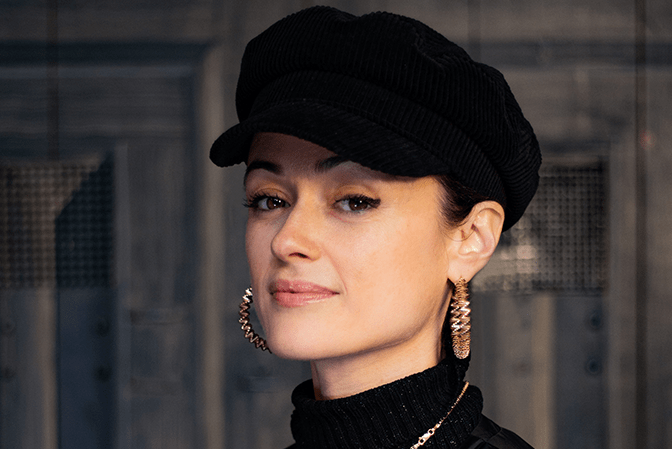
Sabrina Mahfouz’s 2025 PEN Pinter Prize encomium.
PEN Transmissions is English PEN’s magazine for international and translated voices. PEN’s members are the backbone of our work, helping us to support international literature, campaign for writers at risk, and advocate for the freedom to write and read. If you are able, please consider becoming an English PEN member and joining our community of over 1,000 readers and writers. Join now.
This speech was delivered at the PEN Pinter Prize ceremony at the British Library on 10 October 2025.
~
Thank you to English PEN for having me here, and for the depth of their work over the many years they’ve been fighting tirelessly for the rights, freedoms and lives of writers.
Also shout out to the late Harold Pinter, for being the inspiration behind this prize and for helping reveal, to me who began my career as a playwright, and to many others across the many worlds of literature, that to write with urgency and purpose in pursuit of exploring the real truth of our lives, can bring unparalleled joy, impact, daring and sometimes, sadly, danger. But of course, the biggest thank you tonight is to Leila Aboulela, for whom we are all here this evening, and whose name has been synonymous in my mind with joy, impact, daring and danger, in the best ways, since the very first book I read of hers.
This book was her 2010 novel, Lyrics Alley, a love story backgrounded by the 1950s time of Sudanese independence from British colonialism. Each character in the epic expanse of the book having a varying relationship to Islam and their own perspectives on everything from polygamy to poetry. I knew then that her work was an absolute balm to sensationalism, as she delved deftly into the details of internal lives that led to individual choices which can’t be quickly explained away by taking one side or another.
When I read Lyrics Alley, I was pregnant, broke, and unable to see how I would continue as a writer while caring for a tiny human indifferent to my deadlines. Though it could not restore lost sleep or alter the unrealistic demands placed on creative work for meagre compensation, its political backdrop bursting with revolution, its inherent poetry inextricable with spiritual meaning and its cast of problematic family members who didn’t always redeem themselves, offered something invaluable: hope and perspective. It gave me faith.
Faith, though often unfashionable in the arts, emerges in Aboulela’s work not as an oppressor, but as a source of solace – a well of deep knowing. It is from this well that logic can be drawn to guide her character’s hardest decisions, rather than serving only as a tool for irrational or violent acts, as faith has so often been used in contemporary literature. For Aboulela, faith and storytelling are inseparable, evident not only in her characters but also in her use of spiritual journeys as structures, such as the Sufi Seven Valleys pilgrimage-inspired journey in her novel, Bird Summons. As Islamophobia, anti-Semitism, ethno-nationalism, and the co-opting of Christianity for fascist ends threatens our present and future, it is vital to read works like hers and remember that the pursuit of a spiritual life need not serve any agenda but our own yearning for meaning.
And everyone, of faith or not, is currently searching for meaning in this in between time we find ourselves living through. A time of transition and transformation, that seems to be marching forwards and running backwards with equal force. Transformation is at the heart of Aboulela’s characters. They dwell in the in-between, perpetually in process, never complete, and finding something resembling wholeness only through acceptance of this perpetual state, experienced through the body and through place.
Walking on unfamiliar ground in strange countries and new cities, Aboulela’s characters’ feet touch the earth and it is theirs, even if they are unsure of it. Whether through the plains of Russia, the heaths of Scotland or the alleys of Khartoum that they walk through in her Caine Prize-winning novel The Kindness of Enemies, or on the shores and in the living rooms of Algiers, where her characters renegotiate their steps with one another in her subversive play The Insider, Aboulela reminds us that no matter where we find ourselves, we are all simultaneously visitors and locals, with the same earth beneath our feet, from Gaza to Glasgow.
In these tumultuous times, such acceptance and awareness is essential for survival. Stability, assurance, and solidity now feel oddly nostalgic. Perhaps they were always illusions. Either way, they are now certainly shattered even for those who had the luxury to believe in them. Yet, as Aboulela’s characters show us, we can thrive in the unfixed, in the in-between. This is where work is done, where transformation occurs, where it can be easier than ever to find the people who know the future can be reshaped whilst it is in flux. And where those who greet uncertainty with curiosity and openness, rather than anger and violence towards the most vulnerable, will guide us to a better place.
For now, that better place may exist only in literature and imagination. A world where genocide, the systematic slaughter of human beings of all ages, talents and types, is neither used, endorsed, nor enabled for any reason, least of all for land and resource deals benefitting those already overflowing with wealth. A future where ‘tomorrow’ means more than short-term profit margins; a time when our descendants can enjoy their fleeting presence on earth without suffocation or fear of being swept away by wind, water or bombs. A place where states are not mere banks for corporations to withdraw public money from, but act genuinely for the public good, refusing to gaslight those who have contributed most, or persecute those who have the least.
Until then, Leila Aboulela’s literature lets us hold onto the possibility of transformation, the solace of faith, and the power of storytelling to imagine a future which we can shape, if we take a step.
Thank you Leila, for all the steps you’ve already taken.
Sabrina Mahfouz grew up in London and Cairo and is a writer of books, plays, TV and poems.
For TV she has recently worked on HBO’s Full Circle; A24’s BEEF and #1 Happy Family USA.
In theatre, she recently wrote for Danny Boyle and Boy Blue’s dance adaptation of The Matrix, Free Your Mind. She was an
inaugural Writer in Residence at Shakespeare’s Globe Theatre, where she co-wrote an adaptation of Ovid’s Metamorphoses. She wrote and performed her cross-genre show A History of Water in the Middle East at the Royal Court Theatre.
Her numerous other plays have garnered a Fringe First Award, Herald Angel Award, Old Vic New Voices Award, BBC Best Drama Award, Radio Academy Award, UK Theatre Award and an Offie Award.
Sabrina is a Fellow of the Royal Society for Literature and has written, edited and been anthologised in a number of books for adults and children.
 PEN Transmissions