
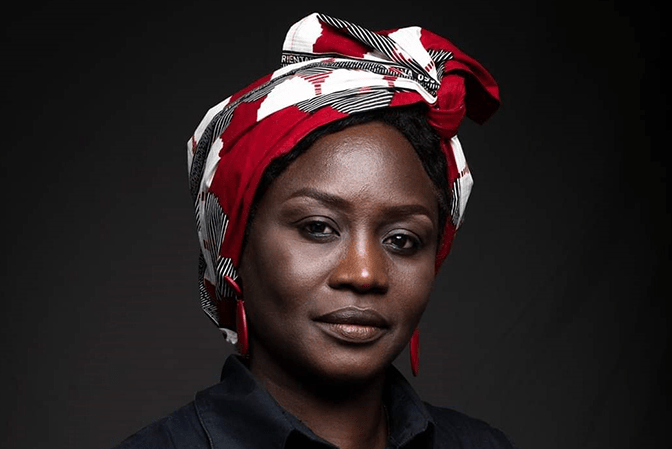
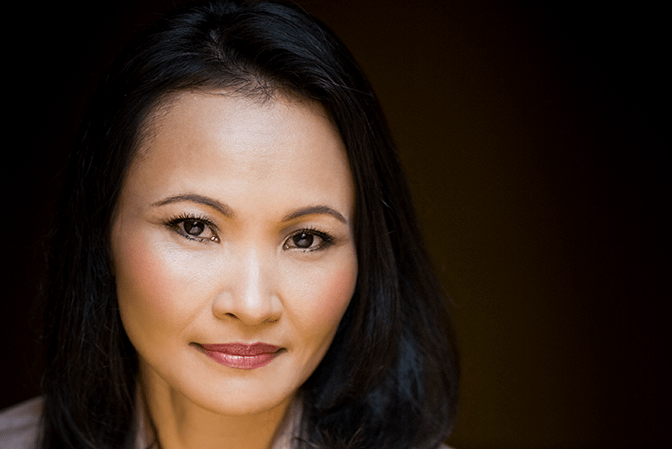
Stella Gaitano, PEN Pinter Prize Writer of Courage 2025.
PEN Transmissions is English PEN’s magazine for international and translated voices. PEN’s members are the backbone of our work, helping us to support international literature, campaign for writers at risk, and advocate for the freedom to write and read. If you are able, please consider becoming an English PEN member and joining our community of over 1,000 readers and writers. Join now.
This speech was delivered at the PEN Pinter Prize ceremony at the British Library on 10 October 2025.
~
My greetings to all of you – as individuals and organisations interested in literature – on this special evening, which is important to me, to Leila, and, of course, to greater Sudan.
We are celebrating a committed pen and a disciplined writer in Leila Aboulela. And from here I would like to congratulate her on winning the PEN Pinter Prize. You truly deserve it, Leila.
Today, two Sudans, beset by war, division, and a loss of political direction, meet at one of the world’s most important awards honouring writers.
We meet as the Blue and White Rivers converge to form the great Nile.
My pen meets Leila Aboulela’s today, like two additional waves, flowing together in harmony.
It is difficult to describe my feelings to you. This news came as a huge surprise to me. I am deeply grateful to the English PEN and to Leila Aboulela. Thank you.
I do not know what to say on such occasions. I still see myself as the rebellious little girl trying to change the reality of her bleeding country by telling stories and writing novels. My country, Sudan, has become two Sudans, and we do not know how many more Sudans it will become if we do not all face the causes of our wars with courage, and stop the bleeding that has continued for decades, stop the wars whose reasons we can no longer explain.
In the late 1990s, I was practicing writing as a hobby. I was a high school student about to be accepted into Khartoum University, carrying notebooks in which I had written my first stories, looking for someone to read and evaluate them. At home that wasn’t an option because I was born to illiterate parents, and there was no one in the family interested in books or writing. The University of Khartoum was an important stop. In and around it, I met writers, poets, journalists, and political activists. There, I met Al-Saddiq Al-Raddi, Osama Abbas, Atef Khairy, and others. They were the first to support me in embarking on my journey into the world of writing. They published my short stories in newspapers, and from there, my creative writing began. In my second year at university, my first collection, Withered Flowers, was published. Its themes are of displacement, homelessness, and poverty, because of the long civil war that had killed and displaced millions. I was trying to understand the war through the characters in that collection. Years later, a question arose: Would Stella write about the war in her next book?
I didn’t know the answer at that time. Until another war broke out in the south, after independence, and I wrote The Return.
I documented the south, which had become an independent state after more than 22 years of civil war. Through it, I tried to understand the meaning of homeland, of borders, of belonging. Was fighting a solution from the beginning? Did we really buy peace in exchange for division? So why are we still fighting and tearing each other apart? How much blood do we need in order to sit down for the next peace agreement?
I discovered that hand-held rifles sought out new enemies, even if they were brothers. The South erupted into war far from Sudan, and Sudan quickly ignited a war far from South Sudan. They didn’t hesitate, for a moment, to kill each other. It’s the same mentality that clings to power and influence – those who denied freedom, practiced corruption.
Then, I found the characters of my first book still in the same state: they had only grown poorer, more ignorant, facing greater environmental crisis and more flooding. Is this the peace we paid such a high price to obtain?
In 2018, I published a historical novel, Edo’s Souls. And then another one, Ireme, in 2024. This a different and new experience. Writing the novel complemented the project of exposing political regimes for resorting to violence as a political solution. I tried to return to history and shed light on some of the atrocities that had been committed and then passed over without the slightest sense of guilt.
Perhaps the idea of exploring the past came from the beliefs of my people in the east of South Sudan. They believe that unresolved problems of the past will cast their shadows and curses on the present and future, unless we acknowledge and reconcile them. Resolving them is as essential as life itself, and for every individual to live in peace. This was my motivation in writing a historical novel and reopening all those old wounds that perpetrators had managed to hide so well. I was writing, afraid that some might misunderstand what I had written and that I would be classified among those who incite conflict and hatred. But I said to myself, ‘We hate and kill each other anyway! People don’t need a novel to kill each other!’ Then I thought, perhaps by describing the ugliness of what happened, it might give us some wisdom to reject it for ourselves and others. I continued writing, trembling with every page and crying with every chapter, until I finished.
In my novels, everyone is both perpetrator and victim – at the same time, and to varying degrees. I want to remove the fingers of accusation that are always directed at others, and instead hold up a mirror. Because at some point the other becomes the self. In Sudan, we need this wisdom, the moment we recognise our own evil and the extent of the destruction we can cause to our homeland and our people. When we reach this wisdom, no one can manipulate us or put their own interests above ours as citizens who have land and resources, and the will to change, so that we can live a life of peace, development and cooperation among ourselves, will prevail.
As an African woman – hoping to live in peace and protect her children from the shadows and curses of the past, so they too can live a peaceful life – I have returned to the wisdom of my people: we must acknowledge what happened in the past, because it is the reason for what is happening now.
Through my writings, I also call on all Sudanese to confront the past.
It is not easy to confront the past. It requires courage to step out of the victim role and admit that I, too, contributed to the destruction in some way, even through silence.
All of us, as Sudanese, need this courage during these difficult times, when war is consuming Sudan and peace in South Sudan is barely holding. It is as if these are not peace agreements but just brief periods to prepare for new wars.
Arming is at the expense of building schools, hospitals, and roads. Tribal polarisation is growing at the expense of unity, coexistence, and peace. This is the behaviour of our leaders.
I reject all of this, because we deserve better than this fate. Through my stories, I also call on everyone to reject what is happening. Because we all deserve better than this violence.
I had been reflecting on all these matters when the news of the award from English PEN arrived. It is hard to describe how I feel. It is, of course, a great honour for me that Leila Aboulela has chosen me to share this award with her. Our great writer Leila Aboulela. It may seem like good news. But when I think about the fact that I might not have been here to witness it, tears come to my eyes. This is not only an award for courage, but also one for survival. I dedicate it to the brave Sudanese and South Sudanese writers who continue to write during wartime, in the absence of freedom of expression. I dedicate it to all the persecuted writers of the world whose words have led them to prison, exile, or death. Telling the truth can risk such threats. But it can also shake the authority that refuses to accept it, grant light and freedom, and promise a better tomorrow. An act with such power is worth the risk.
As Harold Pinter said many years ago, our pens will remain, unflinching and unwavering, for a better future for coming generations.
Stella Gaitano was born in Khartoum in 1979 to a South Sudanese family. She studied at Khartoum University and trained as a pharmacist. When Sudan was partitioned in 2011, she moved to Juba, the capital of South Sudan. However, in 2015, Gaitano returned to Khartoum after facing harassment and attacks for her outspoken criticism of the South Sudanese government, which she accused of mismanagement, corruption, and its role in the civil war. In 2022, she was awarded a fellowship from the PEN Germany Writers-in-Exile programme and relocated to Germany. Gaitano writes in Arabic and has published two short story collections and the novels Edo’s Souls and Ireme. Edo’s Souls, translated from the Arabic by Sawad Hussain and published by Dedalus Books, was awarded a PEN Translates grant in 2020 — becoming the first novel from South Sudan ever to be published in the UK.
In September 2025, translators Mayada Ibrahim and Najlaa Eltom featured among the winning translators in the inaugural round of PEN Presents x International Booker Prize, a grant programme launched to support translators from the Global Majority, for a translation from the Arabic of Gaitano’s second novel Ireme.
Photo credit: Doha Mohammed
 PEN Transmissions