

Christine Wu on reimagining family history.
PEN Transmissions is English PEN’s magazine for international and translated voices. PEN’s members are the backbone of our work, helping us to support international literature, campaign for writers at risk, and advocate for the freedom to write and read. If you are able, please consider becoming an English PEN member and joining our community of over 1,000 readers and writers. Join now.
This piece is in partnership with PEN Canada.
~
Consider my parents’ first date, sharing
what they have in common: a history of being possessed
My parents’ first date shows up in my poem ‘Ancestry.com Has Nothing on Me’. It’s vague on the details, although I considered painting a more robust scene: a little cha chaan teng in Hong Kong where they shared milk tea and egg tarts, or perhaps a stop by a street vendor selling chai and samosas in India.
The truth is, I don’t know what my parents did on their first date, or even what country it was in. What I do know: my father’s family spent much – or perhaps, all – of his childhood in India, my mother grew up in Hong Kong, and somehow their paths crossed before they moved overseas to start a family in Canada. Both my parents knew the taste of samosas and jalebi, of rice and lap cheong, of chilli chicken and Hakka noodles. They shared these foods with me during my childhood in Vancouver, where I grew up in-between cultures, constantly trying my best to fit in. What they didn’t share were the details that surrounded their childhoods, how they met, their migration to Canada, and the toll it took on them.
I first came across the term ‘shadow histories’ in Jenny Banh’s essay ‘Chinese Restaurant Kids Speak about Labor, Lifeways, and Legacies’. Banh refers to a ‘shadow history’ of her family’s time in Southeast Asia that ‘would never be discussed’. Banh writes:
here is a lot of silence and misdirection in [my mother’s] statements to me. Dare I say resistance? She withholds many things from me, and I have to guess or imagine what she means. I think my family history consists of many imaginaries within and between the generations. Maybe within me as well…
Though this was my first time encountering the term “shadow history,” I immediately understood what Banh meant. A shadow history is an unspoken past that lurks in the background, often entangled in trauma, always actively haunting, yet never discussed or confronted head on. This was familiar to me in my lived experience with my family. Like Banh, I also had ‘a silent and evasive family,’ and I, too, learned ‘to not ask questions or talk too much.’
As a writer, I write to understand myself, to process experiences and emotions, and to connect with others. Like many aspiring writers, I was taught the adage ‘write what you know’. It’s sound advice that often produces interesting writing from different lived realities. While writing my poetry collection Familial Hungers, however, I found myself returning to what I didn’t know – aspects of my family’s past that had grown entangled into my life. How and where, exactly, did my parents meet? What were their childhoods like? What buried memories do they carry every day? Over time, my relationships with my family origins have amassed fractures resulting in ongoing breaks in communication. As such, I found myself unable to ask about details from my family’s history.
How, then, do you write about what you don’t know?
As it turns out, writing what you don’t know is made up of research, speculation, and imagination. I wrestled with the incomplete – and possibly inaccurate – facts presented in my poem. Research provided context to some of my questions – Hong Kong was a British colony, then occupied by the Japanese, then a British colony again, before finally becoming a Special Administrative Region of the People’s Republic of China. There was, in fact, a sizeable Chinese community in India, specifically in Kolkata. India was an official British colony from 1858–1947. The Sino-Indian war occurred in 1962. I also had bits and pieces I remembered from my childhood: my mother had a British passport, her father was a sailor who would bring home gifts, she once talked about her family needing to escape India to go back to Hong Kong; my father had a ‘difficult’ childhood. These memories allowed me to begin questioning and speculating: Did my father spend his entire childhood in India? Did his family stay during and after the Sino-Indian war? How did my mother meet my father if she was living in Hong Kong? Did my mother also spend time in India? Could I make up a fake first date for them in my poem? Was it disingenuous to do so?
I found myself attempting to fill in the blanks of what I knew about my family history. Memory is famously unreliable, and my memories of what my mother did share with me in my childhood might be wildly inaccurate. What is the difference between truth and accuracy? How much do the details matter? My parents may never have even had a traditional first date, not the way I ask readers to imagine it in my poem. I ask the reader to imagine a whole host of probabilities whose details I myself don’t know: what it might have been like for my grandmother living through the Japanese occupation of Hong Kong and the subsequent British re-establishment; the realities of being Chinese in India during the Sino-Indian War; my parents’ emigration and their sense of unbelonging in Canada. These imaginaries float between fact and speculation, uncorroborated stories pieced together from bits and pieces that approximate and become a personal history. They’re held together with research, memory, and imagination. What I initially considered controversial – imagination – serves its purpose in revealing an emotional truth. The poem, then, is an imagined family history that may or may not be accurate, studded with interruptions from the history of British colonisation and its lasting effects.
That said, I still worry about the accuracy of details, what my family might think when or if they read my poem, whether they might get caught up in the inaccuracy of the details, whether the emotional truth I am presenting rings true for them in the way it does for me. Whether that same truth will still resonate with me years down the line. As I worry, it occurs to me there are multiple definitions of worry: there is the commonly understood meaning of worry as related to anxiety, but there is also the way worry is used as a verb to describe repeatedly touching or disturbing something. A dog might worry at a bone, or a child might worry the edges of a blanket while falling asleep. While I write, I worry about the impacts of my imagined details while also worrying at the details – changing the location of a first date from a cha chaan teng in Hong Kong to a street vendor in India to something else entirely until the scene feels right. Maybe this worry is part and parcel of writing what I don’t know: doing my best to present an emotional truth while holding onto uncertainty, worrying the details, contemplating their fuzzy edges, and hoping what emerges rings true.
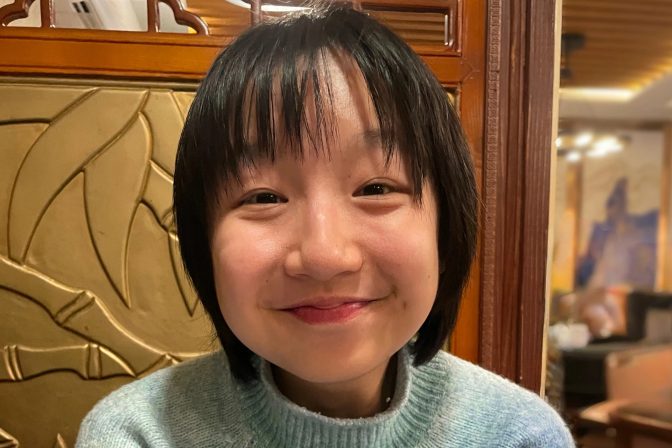
Christine Wu is a Chinese Canadian poet who lives in and writes from Mi’kma’ki (Nova Scotia, Canada), the unceded and ancestral territory of the Mi’kmaq people. She was the 2023 RBC/PEN Canada New Voices Award winner and a finalist for the 2022 Writers’ Trust Bronwen Wallace Award for Emerging Writers. Her first poetry collection, Familial Hungers was published by Brick Books in 2025.
Photo credit: Indigo Clarke Media
 PEN Transmissions