

Magdalena Blažević on the massacre of Kiseljak.
PEN Transmissions is English PEN’s magazine for international and translated voices. PEN’s members are the backbone of our work, helping us to support international literature, campaign for writers at risk, and advocate for the freedom to write and read. If you are able, please consider becoming an English PEN member and joining our community of over 1,000 readers and writers. Join now.
I learn from my sister’s face that fear is cold and has colours. While we hide with our mother beneath the stairs in the hallway, my sister’s face evolves like a bruise – purple turns to yellow, yellow to green. Up until that moment, nothing scared me more than the darkness in the hallway. There lived my nightmare. The wolf.
From my mother’s movements, I know that fear is both panic and composure. It’s a hot summer’s day, yet she takes off her shorts and pulls on her winter velvet trousers. In the face of male assault, women fear more than just death. The threat is no longer imaginary, but clearly visible through the window. One cannot control fear. I tremble with hysterical laughter when my mother warns us that the soldiers have already entered the village, that we must stay silent when they arrive. Because of my innate boldness, she addresses me especially.
My hands are clenched, but I don’t think about fear. Only of escape. In my child’s mind we all survive. There is no other outcome.
Twenty-five years later, I photograph the remnants of that time. My grandmother’s house, the basement, the apple tree and wooden bench, the railway, the field, and the Bosna River. Crime scenes and escape routes. I collect photos, documents, objects. I record the testimonies of survivors. Witnesses. I am a witness myself. I read mine and my mother’s diaries, our letters – everything that will lead me back to that time, to the day I was forced to grow up.
~
As a child, I am a believer. I think death means that the souls of the deceased are in heaven, but I don’t think about the souls of those who survived. The morning after the attack is equally horrifying for the survivors. The narrow dusty road is soaked with blood. It is a hot August day. The blood, thickened by heat, lures the flies. Someone has to wash the concrete in front of the house, to take a shovel and scrape off the top layer of bloodied soil and dump it somewhere, soil that should have been buried with the dead. I know that now.
This task was given to our grandfather. In my child’s mind, he is the strongest man in the world, maybe even the scariest. At that time nobody knew that he was the weakest, that he would eventually fall to pieces and commit a crime himself.
The testimonies lead me to an empty garage that, at that time, served as a morgue. I think about how someone had to lay dead bodies on plastic sheets, in several rows, close the garage doors and leave them there overnight. Someone had to take photos of the motionless faces. At the time, we believed that the photos would serve as evidence in a trial that never began, for a crime that no one was ever held accountable. It is likely that they never will be.
The summer smells of tar-soaked railroad ties, warm blackberries, and crushed tomatoes. It is yellow and dusty. Only the forest and the birds are black. I stand on the balcony of my house and call Ivana, my fourteen-year-old cousin, to come and see how I have decorated my room. She waves at me, and says she will come later, she has other things to do right now. It is the last time I see her. She was killed in front of her home on August 16, 1993. On that narrow dusty road.
At that time, we live in a different village across the Bosna River, but that day we return to pick fruits and vegetables from the garden. Everything is already overripe. If it rains, it will rot. We return by nightfall. Back then I didn’t know that daylight is scarier than the night.
In the village across the Bosna River, we live in a house in front of which grows a large weeping willow. Its branches hang down to the ground, and it is dark inside the canopy. The willow tree is my tent. A hiding place. It’s where I read my first book for adults, The Prisoners by Lajos Zilahy. It is the only book that I have, rescued from someone’s home library. The love story of Peter and Miet. Children gather around me as I read aloud. There is no radio, no TV. We discover worlds through books. They listen carefully during the sex scenes; they don’t care for the rest of the story. I keep the book under my pillow in the room where I sleep. The room is small, there is only enough space for the bed and a narrow cabinet. In it I find expired cake decorations; remnants of shredded coconut, dried almond flakes, colourful sprinkles. I chew and swallow. My stomach growls. I read and think about how, one day, I will meet my own Peter, and I will cry when we say goodbye to each other.
~
As we flee, I realise that there is a wild animal inside me. I run faster than anyone. I leap across the dusty road into dry grass in a single bound, crawling, tearing, scratching my way forward. I crash through the cornfield in front of me, the gravel from the railway scatters beneath my feet. I don’t hesitate, not even at the river. It’s deep and fast even in summer. I take off my shoes, I can’t afford to ruin them, I have no others. Beneath my bare feet moves mud and slimy river weeds. The water rises to my armpits. Just a little further, and we will be safe.
I’ve learned that fear comes with a tightened throat and lungs gasping for air. I can hear my grandmother’s rasping breath as she lowers herself onto the concrete steps in front of the house and begins naming the dead. Liar! I think. She must have lost her mind. My mother gives her sweetened water, but grandmother’s throat is dusty like the road, it cannot be quenched by water.
We don’t go to Ivana’s funeral. The cemetery is on a hill, exposed, visible from the woods like the palm of a hand. To me, she is not dead, just gone. The first proof of her death is a photo from the morgue. It was published by Globus, a Croatian weekly newspaper, in an article about war crimes in Central Bosnia. The entire family is at our house. There are too many people crammed into the room. I sit on the floor. We are all silent. The newspaper passes from hand to hand, wet from sweaty fingers. The children look too. There is no point in hiding anything from us anymore. When I see the photo from the morgue, the wild animal inside me howls. I’m twelve, and I’m scared that we will forget what happened to us.
Years later, I begin writing the story about that summer of fear, death, loss, but also of love. While I’m trying to find and collect material for my novel, I go to that village across the Bosna River. I take my camera everywhere. I walk along the battered road. It’s late summer again. The weeping willow tree has been cut down, and the house renovated. It’s not the same anymore, there is no point in taking photos. An old man is tending to the front lawn. Should I go up to him, tell him that we once lived here. I walk towards the fence then change my mind. I’m not sure it would mean anything to him. I continue down the road to the house where Ivana used to live. It began decaying before it was even finished. I take photos from a distance. I still remember the smell of dust, kitchen grease, and mice. The house is a dark blot in the middle of a blooming meadow.
~
Twenty days after the attack, I learn that a wild animal lives inside our grandfather too. He kills a man, out of rage. They occasionally let him out of prison on the weekends. His thick, unruly hair is now cut short, his glittering eyes visible. He has a rifle, for sure, and he will kill us all. I think. I run inside the house; afraid he will chase me.
I tried to find documents from the trial, to reach more witnesses. I find almost nothing, and nobody from the village wants to talk about it. They know I’m a writer, that anything they say will end up in my book. My grandfather remains an enigma. Both, in life, and in the story.
We returned to the village across the Bosna River in the winter of 1993. It’s safe now, but we are still afraid. We live in soot and cold. Inside, the walls are black from the flame and smoke of the oil lamps, and outside we choke on coal smoke from the chimneys. Winter is black, like a burnt forest, like birds.
We only heat one room in the house, and life happens around the stove. I’ve learned how to make candy from melted sugar and my fingers now smell like caramel. We taste our first candy in a long time. We go to Ivana’s grave and leave some for her under the wooden cross, next to a bouquet of evergreen branches decorated with Christmas ornaments. Somebody takes a photo of us children, standing beside her grave. Small, serious faces. I can remember heavy snowflakes.
At that time, I read even more. On my shelves there are collected works of Ivo Andrić, Marija Jurić Zagorka, and Russian classics. By the stove, I develop an addiction to escaping into fictional worlds, and all I can think about is how to leave this place. I’ll be Countess Nera. Anna Karenina.
My bedroom is freezing. To reach it, I have to pass the dark hallway, past the staircase under which the wolf lives. I no longer run in fear with my eyes closed. I’m no longer afraid of the dark, or the wolf. Only of the forest in broad daylight.
Under my pillow I still hide books.
And keep running, running…
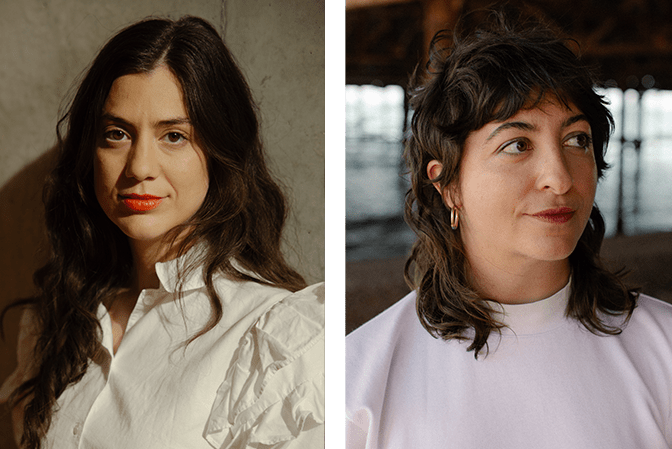
Magdalena Blažević, born in Žepče in 1982, is a writer from Bosnia and Herzegovina. Her stories and her debut novel, In Late Summer, have been translated into several languages, and awarded numerous prizes, including the 2022/2023 Tportal Award for Best Croatian Novel.
Photo credit: Marijana Baskarad

 PEN Transmissions