
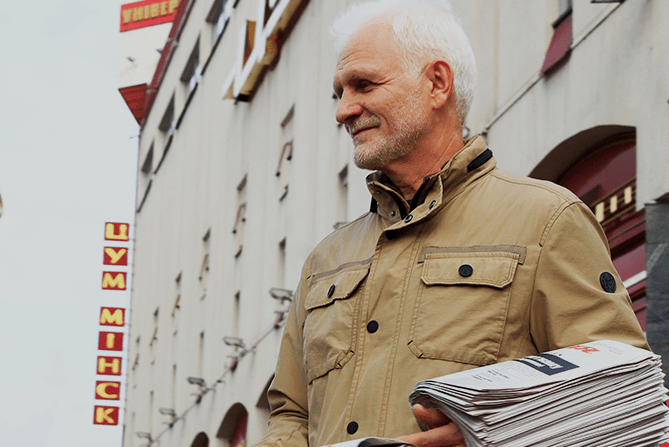
On International Day of Solidarity with Political Prisoners in Belarus, Nobel Laureate Ales Bialiatski on letters, solidarity, and compassion. Translated by Valzhyna Mort.
PEN Transmissions is English PEN’s magazine for international and translated voices. PEN’s members are the backbone of our work, helping us to support international literature, campaign for writers at risk, and advocate for the freedom to write and read. If you are able, please consider becoming an English PEN member and joining our community of over 1,000 readers and writers. Join now.
I always carefully study the images on the postcards. They are extremely diverse. Most often, the subjects relate to animals and birds, flowers and natural landscapes, visual art, and cityscapes. Postcards come from all over the world – from United States and Canada, from Australia and various parts of Europe. I sincerely wish to answer each one, to share with gratitude at least a little bit of the positive energy that enveloped me from head to toe.
But it is impossible: different languages, unimaginable number of letters, limited time. We have no mutual contact. And although the absolute majority of those who write do not expect an answer, the impossibility of answering bothers me badly. I am like that battery, the black box with input terminals, accumulating positive vibes. Will I have enough space, memory, and depth to hold all this positive human energy?
I wonder how worthy I am of such massive human support. An ordinary person with his share of weaknesses and shortcomings, who hardly wants to be a role model for anyone. Or maybe I really don’t understand something, and I underestimate all the significance and depth of the circumstances in which I find myself?
The world has countless problems: war, oppression, violence, cruelty, and hatred. There are entire countries and regions where a human life is worth the price of a bullet from a Kalashnikov. Be it in such a harmless way, with a postcard or a letter, something incites people to send me moral support.
Maybe this is how world solidarity manifests itself? Maybe through these letters of support, a protest against universal injustice is expressed? Maybe they emanate from an overflowing, irrational compassion towards all the offended and oppressed?
Not so long ago, I read the memoirs of a woman of culture, from Moscow. She saw and remembered how, after the defeat of Paulus’s army near Stalingrad, German prisoners were driven in a long column through the central streets of Moscow. Heartbroken people threw bread into this column of captured enemies. Another writer mentioned how they, ‘enemies of the people,’ were given food by saleswomen at Siberian train stations. They came to the trains to sell their milk, cottage cheese, and baked rolls for a good price to feed their children, and they gave everything to the prisoners for free.
Probably, I have become an object that gives other people the opportunity to express their civil position, to show compassion and humanity. Objectively speaking, apparently, there is nothing surprising in this. If people nurture, protect and stand up – often with risk and sacrifice to themselves – for animals, nature, the environment, then why not do the same, even with greater impetus, for our fellow human beings? What’s unusual is the fact that in this case the victim is a human rights defender, who himself tried to help other people.
And yet it seems to me that there is an invisible connection between me and those who write to me without expecting a reply. In these letters and postcards, the victim, who I don’t consider myself to be, often turns into a hero, who I am not, but whom others would like to see in me. A victim and a hero in one person are actually neither a victim nor a hero.
Ales Bialiatski, born on 25 September 1962, is a literary scholar, essayist, and human rights defender. He was a founding member of the Belarusian literary organisation Tutejshyja (The Locals) and formerly served as head of the Maxim Bahdanovich Literary Museum in Minsk. In April 1996, he founded the Viasna Human Rights Centre, an organisation that campaigns for opposition activists who are harassed and persecuted by the Belarusian authorities. Bialiatski was awarded the Nobel Peace Prize in December 2022 alongside the Russian human rights organisation Memorial, and the Ukrainian human rights organisation Center for Civil Liberties. On 21 May 2023, to mark the International Day of Solidarity with Political Prisoners in Belarus, PEN International published a letter signed by 103 Nobel Laureates, expressing solidarity with Bialiatski. In May 2024, the UN Working Group on Arbitrary Detention found his detention to be arbitrary and called for his immediate release.
Valzhyna Mort was born in Minsk in 1981 and moved to the USA in 2005. Her most recent book, Music for the Dead and Resurrected, came out with FSG in 2020 and was the winner of the International Griffin Poetry Prize and the UNT Rilke Prize. Her earlier collections of poetry are Factory of Tears and Collected Body, both published by Copper Canyon Press. Mort has been honored with fellowships from the Guggenheim Foundation, the American Academy in Rome, the National Endowment for the Arts, the Lannan Foundation and the Amy Clampitt Foundation. Currently, she is the Director of the Creative Writing Program at Cornell University. Mort writes and publishes in English and in Belarusian.
Photo credit: Viasna Human Rights Centre.
PEN Belarus protects writers and other creators, cultural and civil rights and freedoms, humanistic values, and identity by creating and providing space for the development of Belarusian culture, creativity, and intercultural dialogue.
PEN Belarus delivers literary awards, festivals, creative residencies and educational projects, systematic monitoring of the cultural sphere, advocacy and support for repressed cultural figures, and the development of cultural rights and human rights in Belarus.
PEN Belarus operates thanks to donations. By supporting PEN Belarus, you:
- become an ally of repressed creators and join in defending courageous and free-spirited writers, poets, essayists, and translators;
- support the documentation of repression, persecution, and torture – crimes against cultural figures will not be hidden or silenced, repressed individuals will receive support, and perpetrators will be brought to justice;
- help translate masterpieces of world literature into Belarusian. Literary translation is a form of smuggling freedom, democracy, and human rights – a way for Belarusian readers to touch the world of freedom while still living under unfree conditions.
Patreon: https://www.patreon.com/c/penbelarus/posts
One-time donation: https://buy.stripe.com/14k7vK1Ij9890nefYY



 PEN Transmissions