
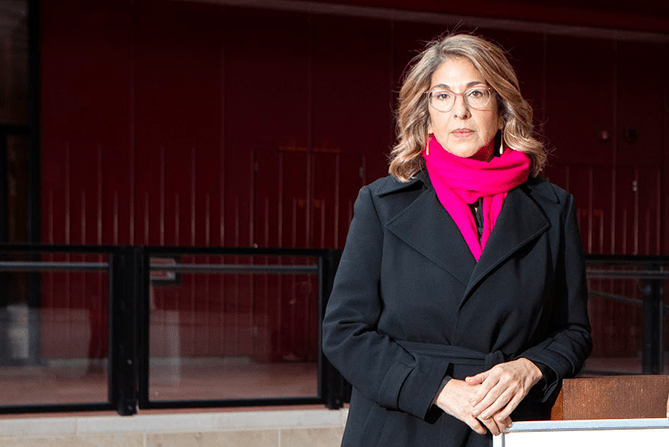
Naomi Klein’s PEN Pinter Prize 2024 encomium.
PEN Transmissions is English PEN’s magazine for international and translated voices. PEN’s members are the backbone of our work, helping us to support international literature, campaign for writers at risk, and advocate for the freedom to write and read. If you are able, please consider becoming an English PEN member and joining our community of over 1,000 readers and writers. Join now.
This speech was delivered at the PEN Pinter Prize ceremony at the British Library on 10 October 2024. It was first published as an exclusive in Mada Masr.
~
Thank you for this invitation. There are few activities I enjoy more than praising Arundhati Roy.
Under normal circumstances, I would be more than happy to spend all of my time on stage recalling favourite characters in her gorgeous novels, and reminding all of you of some of her greatest one-liners.
And no, I’m not talking about the ones about another world breathing that were the italicized email signatures of half the people you knew in early 2000s.
I’m not even referring to the ‘pandemic is a portal’ – those words that pierced the early shock of Covid-19 and helped so many of us to grasp that this cataclysm was going to take us somewhere new and different, and that we had urgent choices to make about what we wanted to bring on that journey.
I’m talking about deeper Arundhati cuts, lesser-known framings that also helped us get our bearings and keep our wits when history suddenly started moving in fast forward.
Like after 9/11, when George W. Bush declared ‘you are either with us or with the terrorists’ and Arundhati reminded us then that we did not have to choose between ‘a malevolent Mickey Mouse and the Mad Mullahs’ – that all the beauty on Earth existed between those two poles.
Or when US fighter jets pummelled Afghanistan with bunker busters, and then followed up by airdropping packets of food aid, and Roy described the display as ‘brutality smeared in peanut butter and strawberry jam’.
Or what she said about the way our phones have become extensions of bodies: ‘Imagine if your liver or your gallbladder didn’t have your best interest at heart.’
Or her scathing take on middle class, professionalized environmentalism, which, she says, ‘Asks the question: How can we change without changing?’
I could go on – I’m a collector, you see, an Arundhati-ologist.
Her novels create worlds nestled within worlds and then worlds within those. The characters in The Ministry of Upmost Happiness embody and inhabit the riotous, uncontrollable diversity that Roy has, for so long, been trying to defend against the dull, monocrop twins of global capitalism and ethnonationalism.
John Berger once observed that Arundhati’s fiction and non-fiction walk her around the world on two legs. Which means that if we want to understand the uniqueness of her stride, we must look and them together, as companions.
Roy has written dozens of non-fiction essay and lectures, enough to fill over 1000 pages in her beautiful anthology, My Seditious Heart, and then some in her recent follow-up, Azadi.
What becomes clear in these pages is that, after God of Small Things, Arundhati became a kind of self-assigning war correspondent, seeking out the places of maximum pain, maximum injustice, maximum state violence – from Kashmir, the Maoist insurgency, the aftermath of the Gujarat Massacre, nuclear weapons tests, and the movement to defend the Narmada valley from drowning.
But she is Arundhati so she did not write about these conflicts and issues like a war reporter, she wrote about them like a novelist. She brought her tremendous gifts as a writer – her bottomless capacity for imagination, her devastating eye for detail and for the perfect, unforgettable metaphor, to find poetry in protest chants, and gallows humour in guerrilla warfare. So many struggles for justice and survival were better understood, more deeply felt, because she chose to help us see them through her artist’s eyes.
There are some writers, though not enough of them, who are willing to confront the ugliest acts that humans are capable of unleashing onto other humans and the natural world. And there are also writers who search out beauty with great insistence, who fall recklessly in love with the world again and again.
But it is vanishingly rare for the same writer to do both of these things: confront the ugly and still search for beauty. Look squarely into the dead eyes of the mob bent on annihilation – and still hold on to a belief in the potential of masses of people to come together to change the world for the better.
Arundhati Roy is that rare writer. So, too, is Alaa Abd el-Fattah. I was not at all surprised when I learned that Roy had chosen Alaa as this year’s Writer of Courage. Though very different stylistically, their spirits are connected in an almost sibling-like way.
It was my honour to write the foreword to Alaa mind-altering book, You Have Not Yet Been Defeated. Having spent many weeks immersed in his writing, I would also have been happy to spend this short speech tonight praising Alaa’s work – pulling out the insights and sentences that are now permanent parts of my mental architecture.
I could speak to you about his warnings about nationalism, his devotion to participatory democracy, his bold experimentations with form and style. I could share some of the endlessly original ways he finds to express disdain for tyrants, liars and cowards (a trait he shares with Arundhati). I could talk about how rare it is for revolutionaries to look honestly at their own movement’s failures and missteps, which Alaa does with great rigour and care.
All of these qualities, along with his strategic mind and acute analysis of power, made him one of the most important figures the 2011 pro-democracy revolution in Cairo’s Tahrir Square that overthrew the three-decade rule of Hosni Mubarak. There is so much to say.
And yet as I sat down to write this appreciation, of both Arundhati and Alaa, it felt impossible to simply focus on their words – the books, essays and turns of phrase. Nor did it seem appropriate to focus on their impacts – the significance they hold to millions of people fighting for justice, liberation and dignified lives inside and outside their home countries.
I kept getting stuck on a simple fact. That, though their circumstances differ greatly, both Arundhati and Alaa are in danger. In fact, when English PEN invited me to deliver this encomium, the letter contained a caveat, one that should startle us: ‘Given the state of the world, and the targeting by governments of both Alaa and Arundhati, we’re aware that it’s possible that both will be able to join us in person, but also that neither will.’
Alaa should be with us tonight, having finished serving his latest, absurd, sentence twelve days ago. The British government should have used every bit of leverage that it has – and it plenty – to make sure that he was here. They clearly did not. Alaa has already lost more than a decade of his life to Egypt’s dungeons – an incarceration so prolonged, torturous and arbitrary that his mother, Laila Soueif, calls this latest extension ‘a kidnapping’.
Meanwhile, just as English PEN’s decision to award the Pinter Prize to Arundhati Roy was announced, reports came that she could face charges under India’s draconian anti-terrorism laws, with very severe implications for her freedom. That news led to a media frenzy, which put her in further danger, the kind of thing that has brought angry mobs to her door before.
Arundhati is here, thank goodness. But it’s a reminder that we cannot take any writer’s freedom or safety for granted, no matter how renowned or celebrated.
A huge part of what I cherish about Arundhati and Alaa is that, like the best public intellectuals, they help us understand our moment in history. This is hard: change is constant and mostly incremental; the big shifts tend to sneak up on us. So how do we know when we are in a new chapter, one that requires different things of us? We know, partly, because our writers tell us.
‘The pandemic is a portal’, Roy said, we’re going somewhere new. Pay attention.
Alaa, from jail, helped his comrades understand that the Tahrir revolutionary moment had passed, and new strategies were required. A defeat did not need to be the end of the story, but he knew that you can’t write a new chapter if you are stuck in the old one.
I point this out because I think that this night – when it was entirely possibly that neither of our honourees would be free enough to be with us – is telling us something important. I think it’s telling us that we have entered a new era. I think it’s telling us to pay close attention.
Arundhati and Alaa are famous writers so we know about their cases. But thousands of lesser- known activists, journalists, academics, and lawyers are currently imprisoned in India’s jails on draconian or entirely trumped-up charges. And those are the ones who have not been assassinated in the streets after being declared enemies of the state.
In Egypt, human rights group estimate that there are some 60,000 political prisoners behind bars. An unfathomable number, one that helps explain why building shiny new prisons is one of the current regime’s most successful enterprises.
In light of these facts, I want to underline something that can get lost in the apolitical discourse of human rights. Arundhati and Alaa are movement writers – writers whose voices are inseparable from the international resistance to the steamroller of corporate globalism and militarism that surged at the turn of the millennium. The movement looked different in every country, but before social media existed, we were connected to each other and we understood that we were fighting different fronts of the same struggle. From Chiapas to Palestine, Narmada to Genoa, Tahrir to Occupy Wall Street.
This was the other world that Arundhati could hear breathing on a quiet day, the worlds that were always there.
I point this out because the state repression and harassment that these two writers face cannot be pried apart from the repression of the movements they helped build and that built them. Nor can the repression of these movements be pried apart from the fascistic political forces that are currently rising globally to fill their vacuum. Filling it with hate-filled ideologies that feed off legitimate anger at elites but systematically redirect that anger towards the most vulnerable people in our respective societies. Particularly at the migrants who have been displaced by the wars, climate disasters and policies of economic immiseration that our global movements tried very hard to stop.
As multinational corporations rearranged India in their image, Roy described it as ‘the most successful secessionist struggle ever waged […] – the secession of the middle and upper classes to a country of their own, somewhere up in the stratosphere where they merge with the rest of the world’s elite. This Kingdom in the Sky is a complete universe in itself, hermetically sealed from the rest of India.’
It’s not just India, of course. That successful succession is our world now. And a world like that needs a lot of jails. It needs all kinds of weapons. It needs iron domes – not just in Israel, but everywhere.
Writers with compulsions to tell the truth? Not so much. In fact, there is a special kind of pure, distilled hatred that fascists and tyrants reserve for the people who see them. Truly see them. Or rather, see through them.
And not only see through them but represent a true alternative to them – a politics built on love, solidarity and an open-armed embrace of the magnificence of our differences.
At English PEN, you know that writing is always dangerous business somewhere. That’s why you exist: to champion the pen over the gun and the prison cell. But as we honour these two writers who are both at escalating risk, from countries where the jails and morgues are crowded with other truth-tellers, we must contend with the reality that we have entered a brazen new stage of state violence.
And nowhere more so than in Palestine. According to the Gaza Ministry of Health, the total number of journalists killed in Gaza in the past year has reached 176, with 32 journalists in prison.
Just a few days ago, an Israeli strike murdered the 19-year-old Palestinian journalist Hassan Hamad in his home in the Jabalia camp in North Gaza. His remains were reduced to a shoe box.
His colleagues shared a WhatsApp message he had received. It said: ‘Listen, If you continue spreading lies about Israel, we’ll come for you next […]. This is your last warning.’
Yesterday Israel shot and killed Al-Aqsa TV photojournalist Mohammed al-Tannani. Al Jazeera’s Fadi al-Wahdi was shot in the neck. Also yesterday.
So if you don’t mind, tonight’s encomium is for Arundhati, and for Alaa. But it is also for Hassan and Mohammed and Fadi and so many others who believed so fiercely in the power of witnessing that they risked everything to try to shake us into action.
None of this is safely over there. In North America, solidarity with Palestine is costing jobs and reputations. Students and professors calling for divestment have been brutalised on their own campuses. Climate activists in this country are getting multiyear sentences for trying to peacefully raise the alarm about the kind of cataclysmic storm that is bearing down on Florida as we meet. And just a few weeks ago, anti-migrant pogroms broke out in the streets of your major cities.
We are all inside this dangerous new chapter, connected to one another. There is fear in that, but there is strength too. It means there are many new alliances to make, new solidarities to forge, new strategies to devise. And new courage to find. Because as Alaa’s words remind us we ‘have not yet been defeated’.
Naomi Klein is an award-winning journalist, columnist, and the international bestselling author of nine books published in over 35 languages including No Logo, The Shock Doctrine, This Changes Everything, No Is Not Enough, On Fire, and Doppelganger: A Trip into the Mirror World which won the inaugural Women’s Prize for Non-Fiction in 2024. A columnist for The Guardian, her writing has appeared in leading publications around the world. She is the honorary professor of Media and Climate at Rutgers University and is Associate Professor in Geography at the University of British Columbia where she is the founding co-director of UBC’s Centre for Climate Justice.
Photo credit: George Torode
 PEN Transmissions