

Issam Kourbaj on found art, the imagery of boats, and urgent archives.
PEN Transmissions is English PEN’s magazine for international and translated voices. PEN’s members are the backbone of our work, helping us to support international literature, campaign for writers at risk, and advocate for the freedom to write and read. If you are able, please consider becoming an English PEN member and joining our community of over 1,000 readers and writers. Join now.
Issam – thanks so much for speaking with me. Much of your work involves found artefacts and found objects. I want to start by asking: have you ever regretted not picking up an object? Or have you ever regretted what you’ve done with one – thinking, after using it, there was a different piece of art in it?
It’s a very beautiful question. I haven’t thought much about the objects I’ve had bad conversations with, if you like, but here is one that just came to mind. Many years back, I picked up a World War Two hospital stretcher and converted it into a stool. Within that stool I made a window, and within that window I installed a video camera running a video piece called Don’t Look Back – when video was still an exotic part of our existence. It was a stool that looked steady, but had originated from a stretcher, an object that in many ways isn’t about steadiness. But whenever I revisit it, I wish I hadn’t done that. I wish I had left it to speak in its original voice; I wish I had worked with that voice, rather than converting it. I enforced myself too much on that piece. These days, I feel much more at ease at not interfering too much with an object’s voice and form.
Are there things I wish I’d picked up? There are many books, from many places, that I simply didn’t have the means to carry all at once. But there is one book that particularly comes to mind: I was in Damascus in 2007, and I saw a very beautiful book in Arabic that had been damaged, broken to pieces and pages torn out, its spine stitched and repaired by many hands and threads. I didn’t know at the time that I wouldn’t be able to return to Damascus again – that it would be my last visit. If I had picked it up and brought it back with me, it would have been such a forecasting metaphor, telling evidence, and an appropriate object to deal with the present and ongoing situation in Syria from a distance. It would have been a reading of an unforeseen future I wouldn’t have imagined.
That’s a very beautiful answer – thank you. When you do pick up a book – when you select it as something that you will transform and transmute into a piece of visual art – what it is that makes you pick up that book? Is it the materiality, its aesthetic as an artefact? Is it the content of the book, its literature? Is it both?
It depends on what I’m working with. In 2015, I made an installation called Another Day Lost. It was a huge miniature model of a refugee camp: small tents made from book pages and medical boxes, surrounded by burnt matches – one for each day since the start of the Syrian uprising. Every day at 12 noon, I went and burned one more match and added it to the piece – a sort of living sculpture, if you like. I needed tonnes of books, because the installation was in five locations simultaneously. So I went to an Oxfam bookshop and asked them ‘Do you have any books that you just cannot sell?’ They said they did, and they sold them to me for 1p each. Hundreds of them. They still had to be about particular subjects, materiality and categories, though – home, migration, war, language; subjects related to a refugee camp. I took those ideas and found books that related to them in different ways – ‘home’ might have been a book about making cakes, ‘migration’ a book about birds. But the magic – something I didn’t anticipate – came when I spread these former book pages and medical boxes out as miniature tents, and, when you came close to them, you found poetry in accidental marriages between images and words. A flower next to a tank. Those connections were so spontaneous. So there was intention in selecting those books, with diverse readings on home or lack of it but also the accidental magic created by the viewer.
The whole idea of using books came when I was in Cuba. In Havana, people were taking furniture to the beach, breaking it to pieces, and making boats to migrate to Miami – the furniture of the old home being used to make the journey to a dream new one. I was working on The Epic of Gilgamesh, and was drawn to use pieces of found chairs, where you could read the remnants and forms of the furniture. And when I came back from Cuba to Cambridge, I started seeing much more clearly what was available around me. In Cambridge, that was books. And my art pieces started involving and responding to them.

Serendipity seems to run through your work. The serendipity of your experiences, and how they inform your work; the serendipity of how meanings land together; the serendipity of political moments and material conditions shaping how your work is viewed.
Yes, it does. Years ago, I met a wonderful Scottish woman who had a beautiful Encyclopaedia Britannica from her father. She didn’t need it anymore, but didn’t want to throw it away, so she gave it to me. For three years, the volumes sat in my studio; I didn’t know what to do with them. Then, one day, I just sat down and started working with them. Against all this alphabetised knowledge, all this wonderful material, I created my pieces. The series is called One + eleven = two, because between two drawings you see in one volume are eleven that you don’t. That was when I started really using books in my work – I mean, working with their content, but not being restricted by it. Sometimes, I saw a word. Sometimes, an image. Sometimes, maps, or nothing. Serendipity. I spent seven months going through and responding to the forest of words, and occasionally to the illustrations and maps.
Words are forms of practice as well as material for your work. In Urgent Archive, there are names of women written – or maybe drawn – in Arabic on the glass window at the front of Kettle’s Yard. You wrote those names with your non-dominant hand an in reverse – or maybe you drew them. Could you talk a little about names and naming in your work, and about your non-dominant hand?
The moment you asked that question, it took me to a place. A very appropriate place. When I was a little boy, I couldn’t form the first letter of my name. As the letter ‘I’ in English sounds like an ‘eye’, in Arabic ع also sounds like an ‘eye’. Another serendipity. I came crying to my mother, so disappointed with myself, and she asked me what was wrong. ‘Look,’ I said. ‘I cannot write this stupid letter.’ She asked me to show it to her. She was illiterate, but she looked at the letter and held my hand in hers and copied it – once, twice, three times – and then let it go, and I carried on copying it until I could form my ‘eye’. She said to me: ‘Don’t look at it as a letter. Look at it as a drawing.’ And that stuck with me, that very beautiful and generous idea that a letter is a drawing, that a drawing can form a language, that language is made of fragments of drawings. That’s something I’ve held onto when making found poetry – that words are sculptures.
Much later, I started teaching her the alphabet. She wanted to be able to write to my children, my two boys. In one note to them, she drew the alphabet and the numbers. That was a very powerful experience for me – how she was trying to teach them as she was learning. I made some pieces in response into her precious handwriting, including a piece made upside down and with my wrong hand. I was trying to be closer to her by imitating her. It was called Afterimage. And I found that, while my right hand – the adult – was overtrained, my left – the child – was still fresh. In fact, whenever I’m stuck, I go to my left hand. My non-dominant hand is a treasure.
In 2000, when I was asked by a photographer which object I would most like to take into the new millennium, I took weeks to decide. Then, when I invited him to my studio and had nothing in front of me, and he asked what I had chosen, I held my left hand in my right. That was my object that I didn’t want to lose.
When I made that window in Kettle’s Yard, I used it: if I had used my right hand, it would have been pure recording; with my left hand, I could breathe slowly, read the names slowly, and think about the enormity of the loss. The window piece was an extension of a piece exhibited inside the galley called Killed, Detained and Missing, a list of women written on an old pianola role, next to a speaker where I recited these names.

You talk about your right hand being overtrained, and it turns me to a question I want to ask about your training. Or, specifically, about training and place. You’ve talked elsewhere about your study in different practices, and about how those practices aren’t labels but a network of practices coalescing. But what I’m interested in is the relationship between training and geography – about the relationship between form, and the spaces in which those forms entered your practice. Syria, Russia, Cuba, the UK; painting, drawing, writing, theatre design (not in that order). How does space bear on practice?
I come from the volcanic mountains in the south of Syria. So even my journey to Damascus was about a different geology, different accents. And then, in Damascus, I was in a tiny room (nicknamed the Half) in a big city – an old Damascene house, where all my materials as a painter had to fit into that small, low-ceilinged room, but everything around me in Old Damascus was material for painting. In fact, as well as regretting not picking up that book, I regret that in those days I did not look more, see more, excavate that present. I had a very intense four years there, where I started sculpting and re-sculpting my ways of seeing. The mud of Old Damascus became my mud. But I needed to breathe after the intensity of the early 80s, and I left for Baku, and then Saint Petersburg.
That’s where I dived into theatre as a solo performer – and I hadn’t expected, at all, that this was a language I would dive into much later in my life. I found I could convey a feeling without saying a word, and that was very special to me. It shifted my practice – there was more about the relationship between body and space, body and light. Gorbachev was doing his perestroika, and I was doing mine (to myself). Damascus was fine art, Arabic, heat, south; Saint Petersburg was architecture, Russian, freezing cold, north.
And then I came to Cambridge, where everything is so miniature-like. After Saint Petersburg, Cambridge looked like a theatre set, but it was also where I had studio space for the first time. Theatre design was an obvious thing to study in London. But I knew I was not an architect, nor a theatre designer. Having my studio next to the ADC Theatre, and encountering all the old props discarded behind it and using them in my work, is how that space most shifted my practice.
I take my studio for a walk with me wherever I am. I take my eyes with me too. And I pick up objects from a place, not reading at the time what these objects might become, just letting it sit, letting them tease me a bit and teasing them back, then the action of seeing but not seeing the final product, and then finding that the piece is shaped by all these conversations, places and forms. That’s a bit dangerous for an artist known for a particular style, a particular language that people expect of us. But I’ve found that, though I love painting and I am a painter, I don’t mind venturing into unfamiliar mediums, novel places. This risk enriches me, and enriches my articulation of a feeling.
So maybe it’s about the serendipity of how place and time and form encounter each other, but the constancy of your eye amid all those shifting encounters.
I’d like to take this idea of movement and return to the idea of migration you mentioned earlier. Migration has figured in your work for decades. And the figure of the boat has been an ongoing part of this. You’ve spoken elsewhere about how the boat has been, for you, a way to articulate the violence of conflict without centring images of conflict. And I’d like to explore the ethics and aesthetics of the boat a little.
I was at Glastonbury this year, and Banksy’s inflatable boat passed a few feet in front of me in a crowd. By the time I’d left the crowd and got signal on my phone, critics and politicians and voices on social media had all already weighed in with loud (often awful) opinions about it. Because of our polluted political and cultural discourse, the image of the boat has become so contested and fraught – often as a way of avoiding talking about the boat itself. Easier to address an artist’s work about refugee deaths than address refugee deaths themselves, perhaps. As an artist with many famous works involving boats, I’d love to hear your thoughts on this.
Thank you for asking this. You see, this is the problem with creation. There are three stages to any creation: pre-creation, the process of creation, and the process of seeing it in hindsight. And they don’t necessarily reveal the same picture. And relationships with the actual and the metaphorical shift, too. Boats have meant different things in my pieces – and different things, of course, to the audiences viewing them.
I made a model of the Bibby Stockholm barge out of sardine tins, called Keep Them at Bay. I was playing with language, with material, with scale to respond to this inhuman solution. Another piece: on the day the Rwanda Bill was agreed, I made a performance called Stop the Bombs, Not the Boats: I took children’s milk bottles, filled them with red ink, and threw them onto a flattened tent so that it was bleeding, and walked with the stained tent to the top of Castle Hill. That piece is about the boat – the metaphor of the boat – even if it doesn’t use the image of the boat. And then there is the 101st piece for the British Museum’s 100 objects series, Dark Water, Burning World, the little boats made from bicycle mudguards with their burnt matchstick people. And Precarious Passage, one of these boats sailing through a hole burnt in the book A History of the World in 100 Objects. Actually, I happen to have it with me here now [holds up book in left hand, boat in right hand, and places the boat through the hole in the book]. This is both image and metaphor. You see, migration is not a current issue. It is the history of humanity, and the history of life – cells migrate, trees migrate, ideas migrate. For me, this boat is not a scale model. It is a scale metaphor. We are all emigrants from our first home, the womb.
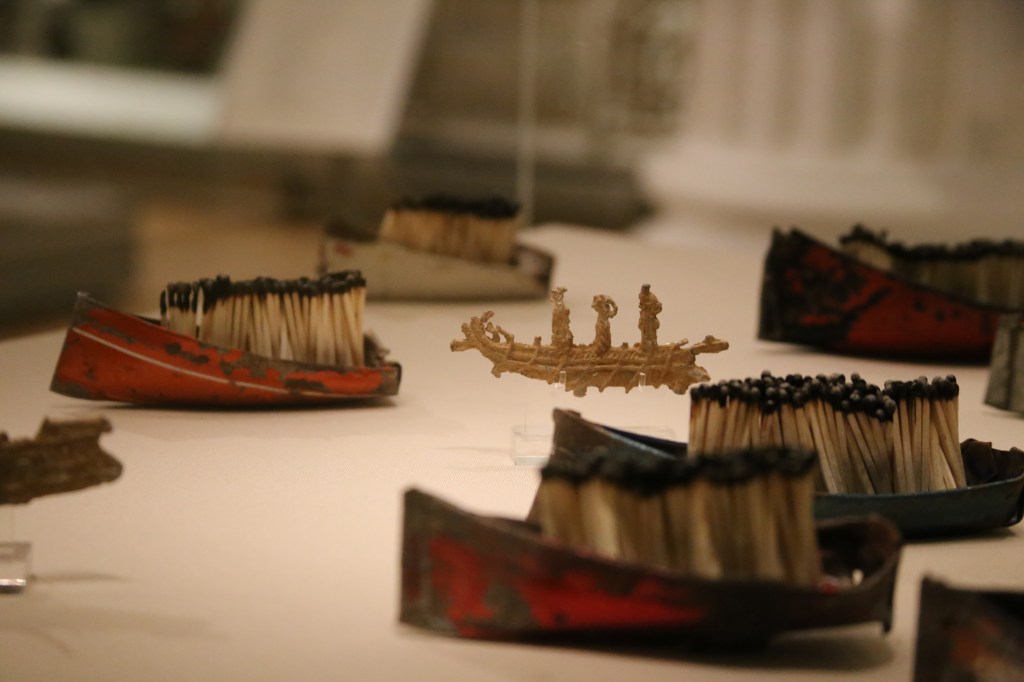
And here’s another piece – Siege Two, which is made from a typewriter, and is dedicated to Marie Colvin, who lost her life in Homs [holds up piece]. If you look [turns piece in the air], it has another shape in the form of a boat. I showed this at the Venice Biennale, in this form – as a sailing, destructed, very fragile boat. I remember being confronted by many questions when I went to the Biennale and saw a real refugee boat that had been rescued. Barca Nostra (‘Our Boat’) by Swiss-Icelandic artist Christoph Büchel. That was not an easy thing. It was so emotional, so suffocating. There isn’t a place for imagination anymore, when reality is surrounding you like this. It took me some time to digest it. I’m having difficulty even thinking about it now. So I suppose I have found that there is a difference between a piece that takes you to something but leaves you to continue making your own journey, and a piece that is in your face, does not let you escape from it, that goes at an aggressive speed, but in our times, I think there is a room and a need for both approaches.
The immediacy of the confrontation – a collapse of image and metaphor into nothing other than that immediacy.
Yes. I think of the carpenter from Lampedusa, Francesco Tuccio, who after 11 October 2013, when 311 people died in the boat that sank there, made crosses for the Eritrean and Somali survivors using wood from the wreck. And then made a sculpture, a large cross, where you can still see the paint on the wood. The Cross was donated by him to the collection of the British Museum. His was a boat made into a cross; mine was a bicycle mudguard made into a boat. I know I am touching but not answering your question fully. And that’s because this is still an ongoing question for me.

Thank you. It’s such a generous answer. And of course it is ongoing – past, yes, and present, yes, but also ongoing and future. I’d like to end by asking you a question to do with tense and time. It’s something right there in the title of Urgent Archive. There’s a story behind that title (and maybe you can talk about that), but I want to ask specifically about the contradiction in it – of archiving, and its sense of slowness and past and permanence, and of urgency. Is it a viable task to archive the present? To have an ongoing archival practice? Or must this always be a retroactive, retrospective endeavour? I don’t want to pre-empt your answer, but I realise we’ve spoken about how a found object isn’t just a thing of a moment; that it is a thing of the past discovered in the present for use in a future, those timelines always butting up against each other. So, a horrible question: is, as artists, there a moral incumbency of archiving as we go, of archiving the emergency and urgency of the present, or can we leave that, for posterity, to the future, as an act for the future?
Ah – a very lovely question. You know, I only encountered the word ‘oxymoron’ very recently. I’m a work-in-progress too – I don’t shy away from that. I think of the phrase ‘leave to remain’, as I say that.
As you reference, the title of Urgent Archive is about Mansour al-Omari, a human rights journalist who recorded the names of his fellow prisoners using ragged strips of cloth and blood as an ink. But the interest in the word ‘archive’ also comes from my interest in seeds. Because seeds are an archive of themselves – archiving their past, their present, their future. In this tiny universe are three tenses all at once. But now let me go back: the first piece I did in relationship to Syria is called Excavating the Present, and it’s all to do with X-ray images, and how mothers in Syria have to collect the body parts of their children in order to mourn them. You know, in many languages there’s no distinction between past and present. And I wonder if the word ‘archive’ is a Western construction of how to deal with the past. It’s such an elusive word. It sounds out that word ‘ark’ at its start – it has a kind of motion in it, of life in it. And life is not fixed: it has multiple tenses in it. My intention is not the past; it is the present, and how one can construct a past or a future from it.

I’ll give you another example. For one of my pieces, I took Aleppo Citadel, and the destruction of Aleppo before the earthquake, and made it out of Aleppo soap. This is a form that transmits itself throughout time: it shrinks, it is discoloured. It’s an interesting archive.
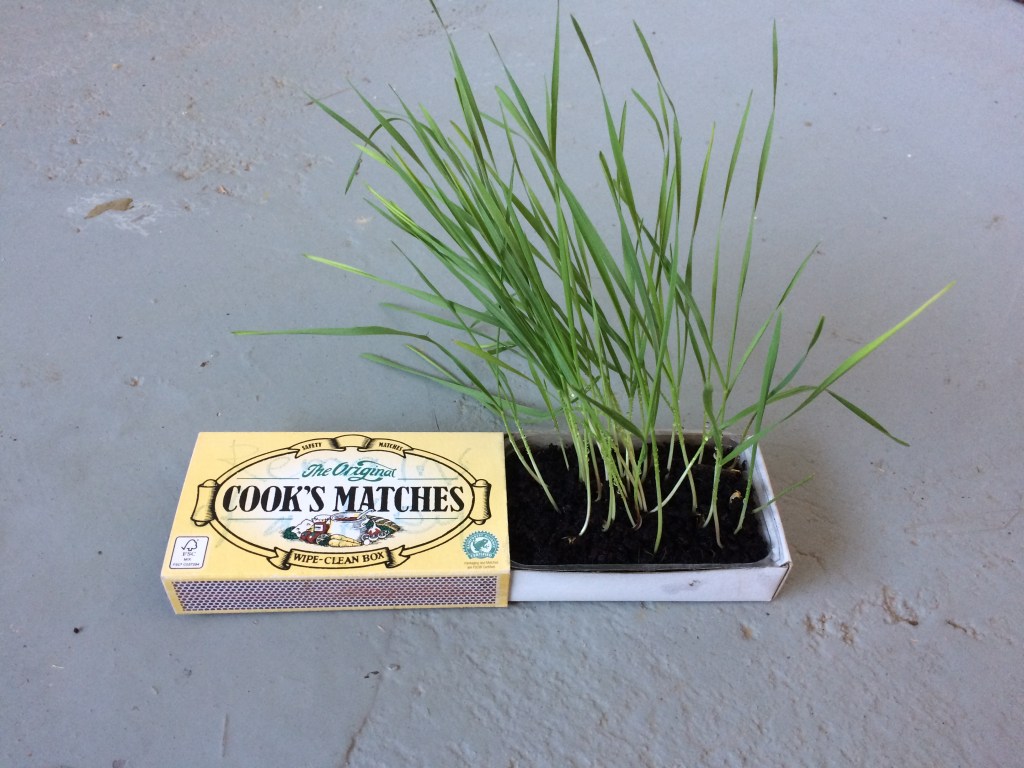
I’ll tell you one more story, and then I will finish. I planted some wheat outside Kettle’s Yard a while ago. I had planned to go and harvest it and make bread though this piece, and tell the story of the bombing of Aleppo Seed Bank and how, ICARDA having lost control of it in 2016, it managed to retrieve the first accession from the Svalbard Global Seed Vault to initiate regeneration and reconstitute the full profile of the collection in Syria. But Syrian wheat and the English weather didn’t work out. It died. And I didn’t want the piece to be about death. So I decided to construct an artist book/ herbarium out of it. I was all prepared and ready to make a performance piece out of this yesterday. But an hour before my arrival, the gardeners unknowingly cleared everything away. I was a little devastated, but I realised there where tiny fragments of the wheat, tiny little remains, from which I wanted to create an archive. These tiny fragments told a story of the whole. I know I’m scratching a tiny mark on the surface of this colossal loss, and that’s what I must do as an artist.
Thank you for these beautiful questions.
Thank you for these beautiful answers, and this beautiful one to end. I’ll tell you what I thought as I sat with the phrase ‘urgent archive’: only when you don’t see life as urgent do you think of archiving as a future act about the past. When you know and see and live emergency, archiving becomes such an obvious emergency act. Timelines capitulate. It isn’t about recording what has gone, isn’t about thinking or rethinking for whom this archive is created: it is simply about a moment, and a moment of preservation. And I think there is something very beautiful about seeing the ways in which artistic practice can be an act of preserving in the present, within which time past, present and future can fall where it may. Sorry – I shouldn’t steal the last word.
OK, I’ll steal it back. You remember your first question about regret? And my answer about that book in Damascus that was so torn to pieces? I see this now: that book was archiving the destruction before it happened. It was sending me a message that I didn’t hear. It was hidden, and was only passing by the market in Old Damascus. This fleeting encounter taught me that one must be present, and almost alert, to sense the hidden. This is why I am trying to make an herbarium out of the fragments of wheat. You see, look at this [holds up a single fragment of a stalk of wheat]. You would just walk past this without noticing it. But though it might sound pretentious, I am going to make a meal from this. A meal for the mind’s eye.
Issam Kourbaj was born in Syria and trained at the Institute of Fine Arts in Damascus, the Repin Institute of Fine Arts & Architecture in Leningrad (St Petersburg) and at Wimbledon School of Art. He has lived in Cambridge, UK, since 1990.
His work has been widely exhibited and collected, and most recently it was featured in several museums and galleries around the world: Fitzwilliam Museum, Classical Archaeology Museum, Kettle’s Yard, Cambridge; British Museum and V&A, London; Tropenmuseum, Amsterdam; Penn Museum, Philadelphia, Brooklyn Museum, New York; the Venice Biennale and the Henry Moore Institute, Leeds.
His Dark Water, Burning World is in the permanent collection of the Pergamon Museum and the British Museum. For the BBC’s ‘A History of the World in 100 Objects,’ Neil MacGregor (the former Director of the British Museum) chose Dark Water, Burning World as the 101st object. Dark Water, Burning World is currently on show part of the Wonders of Creation at San Diego Museum of Art, California.
Interview by Will Forrester, Editor.
Header photo credit: Thierry Bal.
 PEN Transmissions