
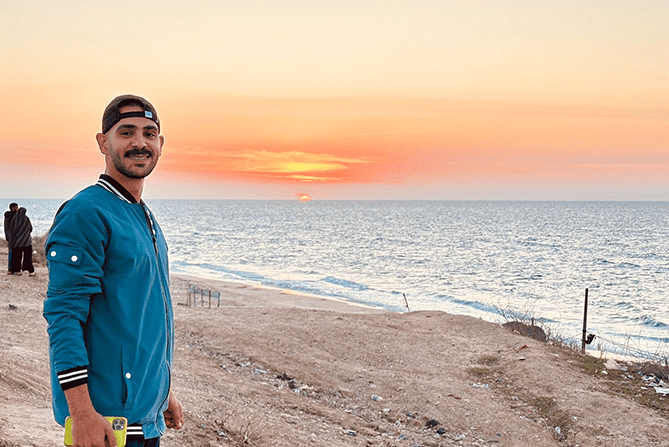
Ahmad Bassiouny writes from Gaza. Translated by Ibrahim Fawzy.
PEN Transmissions is English PEN’s magazine for international and translated voices. PEN’s members are the backbone of our work, helping us to support international literature, campaign for writers at risk, and advocate for the freedom to write and read. If you are able, please consider becoming an English PEN member and joining our community of over 1,000 readers and writers. Join now.
I can’t find an introduction that fits. I’m fed up with counting genocide days. The number of martyrs is high. My fingers ache. I feel as though the teeth of the dead are biting me, clutching at me; I’m a tomb for martyrs, and inside me are many, and the dunes in my heart are dry. I’m an autumn tree; my leaves fall one by one. The tomb is full. Get an axe to cut my fingers. I’m done with counting.
~
All Will Know
Strolling down the souq in al-Nuseirat, witnessing the destruction of homes and markets, I bump into our building’s guard. We engage in chitchat about the ongoing atrocities. He shares the heart-wrenching news that my home and my brother’s have been bombarded. I say, ‘No problem. Money will come again. What really matters is souls.’Material harm, rather than a dear one, as the Palestinian proverb goes in such times of destruction. ‘How are you and yours?’ I ask.
‘I’m still alive, and my wife and children are still with me,’ he says. ‘But the rest of my family has been martyred. My siblings and uncles are all gone. Our building was bombed. They exterminated us.’ His eyes are red.
I console him, ashamed. I share that my niece’s son, along with my cousins’ children, are all martyrs, and that the fate of my niece’s second son – he was kidnapped by the occupying forces – is unclear.
He consoles me, pats my hand, and so I do the same, turning martyrs over in our fingers.
‘Where are you staying now?’ he asks.
‘Here in az-Zawayda. Near the historical site. You?’
‘I took shelter in a storehouse. The people there welcomed me in – may Allah compensate them.’ His voice wobbles.
‘How do you buy what you need?’
My question seems to strike him. ‘I sold my phone for 500 shekels,’ he says. ‘And I’m spending them.’ I see the overburdened pride in him. ‘I need to feed my kids. I sold my phone – so what? Why should I keep it? Who would I call? My family’s all gone. I don’t want any more news. And if I became a martyr, everyone would know anyway.’
~
Muhie/Mukhie
Today, Muhie is sick. A ten-person family was displaced along with us and Muhie is their three-year-old son. He’s in the very first stages of soaking up Arabic, pronouncing ‘ha’ as ‘kha’, ‘sa’ as ‘tha’. Arabic weeps when he speaks. We call him Mukhie the Israeli because the way he pronounces Arabic is like a settler learning it for the first time. Ironically, Mukhie is fair skinned with blue eyes and blond hair. If Israeli soldiers saw him or heard him, they’d think him a hostage.
Normally, Mukhie wakes up, greeting everyone with a cheerful ‘Mornin awl’, and then moves towards me, gives me a ‘Mornin’ too, and asks if there is water, and Arabic weeps.
‘Morning, Mukhie!’ I say, smiling. ‘All the water is for you.’
He has become the soul of the camp. He helps us chop and collect the logs. He plays with the children of the village, acts as their leader. Everyone surrounds him. But at the same time they somehow steer clear.
Muhie’s father is frightened for his children. He tries to shield their eyes from the panic and the fear. ‘When you see a tank, I’ll let you drive it,’ he had once promised Muhie. And then Muhie had admonished his father: ‘We saw tanks and soldiers but you didn’t let me drive. You said “Not now”. I don’t like people lying to me’.
Except it didn’t sound like this. Every word was mispronounced. Arabic wept. If I wrote it how he said it, you wouldn’t understand. But this is Muhie, and this is how he speaks. And the sixty of us on the farm have learned and adopted it.
I ask Muhie’s father about his promise. ‘I don’t want him to be traumatised by the tanks and soldiers,’ he says. ‘So I told him, “I’ll let you drive it unless you give me trouble,” so that he’ll think of the tank as nothing more than a car. Only when he grows up will he understand that it’s the car of the dead.’
But as I say, today, Muhie is sick, grappling with a stomach bug because of contaminated water. He coughs as if a tank is marching over his chest. His lungs are inflamed from the dust of the ongoing shelling. This is a child who thinks life is just a toy: he holds it, turns it over, loosens and tightens its screws, pulls at its rope, all so that he can understand its structure. The crucial point remains: death isn’t a core part of his life.
~
The Tale of Two Cancers
‘A cup of coffee and some water, please. After that, I’ll tell you everything.’ He is Abou Ali, a 55-year-old man. He is new to the farm. He lost his wife and their only child after the occupation forces bombarded the house that had sheltered them for 40 days. They had been martyred shortly after he was displaced.
Abou Ali had refused to leave Gaza. He had promised not to repeat his father’s mistake, not to carry the stories of a third and a fourth migration on his back. So he had decided to stay in Gaza, to witness the occupation’s violence. We don’t like to hear about it, but we must, because collective memory is built on shared scenes, the accumulated narratives of the farmer and the land.
‘As I prepare to go to bed,’ Abou Ali says, ‘I pray three prayers: the Isha Prayer, the Absentee Funeral Prayer for the martyrs, and the Night Vigil Prayer. Then I lie on my bed, and before sleep creeps over my eyelids I place my ID in my shirt pocket and a piece of paper with my full name in my trouser pocket. Just in case. If my house is bombed with me inside, and I’m torn to pieces, my name might then be found in my hand or foot. That one night, as death surrounded us, I took my pen and wrote my name on my hands, my feet, my chest. I felt like a narcissist.’
That night, Abou Ali’s house was bombed. When the window fell onto him, thick pieces of concrete came with it and formed a pyramid over his body. And when the ceiling fell, that pyramid shielded him. ‘I don’t know how I survived. What I did know was that I could no longer stay at home. I headed to al-Rantisi Hospital, where they care for children with cancer. It’s become a refuge for children and families escaping two cancers: disease and occupation.’
He continues. ‘When they controlled the area around al-Karama Street, and they set out from the roundabout that separates al-Karama Street from al-Nasr Street, and the quadcopters fired on every passer-by – that night, I don’t know how I fell asleep. When I woke, it wasn’t to Fairouz’s voice, but the tank’s muzzle hailing me at the window under which I slept. And at that moment, I realised that cancer had spread through the body of the city.’
He continues. ‘They ordered us to hold our IDs in our right hands and raise white flags in our left and exit the hospital one by one. They then directed us to walk in a straight line from al-Nasr toward al-Galaa Street until we reached the checkpoint on Salah al-Din Street, where we could pass to a safe area. I didn’t comply. I veered off from al-Galaa Street toward al-Rimal to reach Shifa Hospital. As I was walking, I saw corpses thrown to the ground – men, women, children, teens. Some had been hit by sniper fire, more than once. Some had been shelled, more than once.’
He continues. ‘Here is a hand and a head. There a foot and a toe. This is a shoulder. I didn’t know who had leaned against it. But it was lying in a long street today, no one to carry it. This street was a tomb with neither tombstones nor sand. Just corpses. Even the undertaker’s corpse was lying on that street.’ He continues.
~
The Story Isn’t a Story, Nor the Hero a Hero
I understand. I understand that we have grown accustomed to stories with happy endings, or at the very least with a hero. Even stories with sad endings have heroes. But here? Nothingness. The story isn’t a story. The hero is not a hero. Nor is Gaza that Gaza that I know, the Gaza I used to tell others about.
Once, in Ramallah, a friend had asked me, ‘Ahmad, tell me about Gaza. What colours is it? How does it smell?’
‘Gaza is shelter for me and all Gazans,’ I had said. ‘The sea is ours; the streets are for us. When I walk in Gaza, I put my hands in my pockets. I know the streets. I never fear getting lost. I never expect an attack from a stranger. I stroll through Gaza in peace, as though I were in my own bedroom. I have wandered the streets of Cairo, Amman, Istanbul, Doha and Ramallah with my hands in the air and nothing in my pockets except for my phone. My hands were ready for strangers. In all my life, in all my places, I have never felt secure anywhere except in Gaza.’
Today, a year and a half after that answer, I now say, ‘You might read, Ghadeer, that all the world is safer than Gaza. Today, my hands are in the air, crossed like Christ. Today, my pocket is a graveyard. When I put my hand into it, my fingers embrace a martyr. Today, the stranger is here. The attack is a silent cancer. Today, I’m fed up with counting genocide days, and the tomb is full.’ shoulder their boats: poets reciting their poetry standing up, writers ached and hunching over their desks, the many named and nameless who carry the suffering of the world on their shoulders to the shores of the sea.
Ahmad Bassiouny is a Gazan writer. He holds an MA in Political Science and International Relations from the Doha Institute for Post-graduate Studies. His work has appeared in various outlets, and he produced a number of documentaries for Alaraby TV.
Ibrahim Fawzy is an award-winning literary translator. His translations have appeared in various literary outlets. He is an editor at Rowayat, Asymptote, and Minor Literatures, and podcasts at New Books Network (NBN).
 PEN Transmissions