
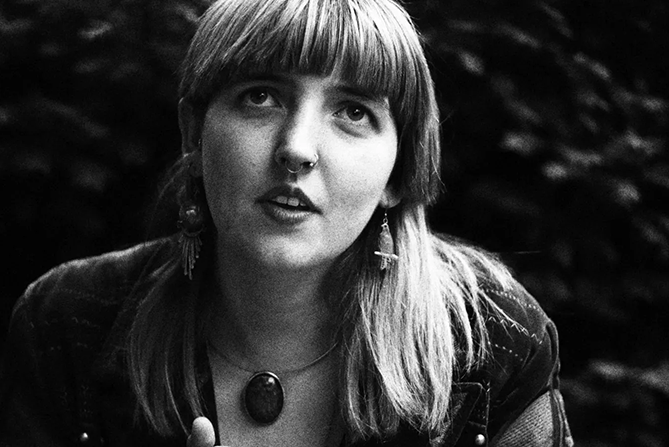
Tallulah Howarth on embracing your poetic mind.
PEN Transmissions is English PEN’s magazine for international and translated voices. PEN’s members are the backbone of our work, helping us to support international literature, campaign for writers at risk, and advocate for the freedom to write and read. If you are able, please consider becoming an English PEN member and joining our community of over 1,000 readers and writers. Join now.
This piece is in partnership with The Writing Squad, an organisation that exists to create and support the next generation of writers in the north of England. It is part of a year-long series, supported by the Norman Trust, showcasing Gen Z writers and writing. Read our editorial on the series here.
~
There is a spectrum of unexpected and expected imagery. We maybe tend to tip towards the safety net of cliché in our writing, but poetry goes beyond a literary exercise in close observation. Poetry – its unexpected imagery – is necessitated outside of our writing. It’s an ongoing commitment to, a deep understanding of, a forging of, a tuning into your version of the world. Yes, dominant cultural narratives exist that may feel safe socially. But it will do you little good to follow these routes. You must decide to walk, to regularly take yourself off the beaten path of your own psyche.
~
This spring, I took myself on a solo day trip to Hebden Bridge – what Julia Cameron would call an ‘Artist Date’ – and walked up towards Hardcastle Crags. I stopped some distance up the incline to note down the paragraph above, unknowingly touching on the initial ideas for this essay.
As Billy Collins expressed in a poetry workshop at the White House in 2011, the idea of a poetic voice is ‘very mystifying in the minds of young people.’ Don Paterson, by whom my MA Writing Poetry class were lucky enough to be given a lecture, thinks our obsession with the ‘great individual voice . . . is worthless.’ I tend to agree. When I hear the phrase ‘find your voice,’ I find it vague, overused, somewhat of a cop-out. What do writers mean – really – when they say you need to ‘find your voice’?
I’ve come up with several possibilities. Maybe ‘voice’ is the themes to which you return, your values, your tone of writing, your language, your sense of identity. Maybe it’s a combination of these things. But surely these are changeable with each new poem? With character poems, the ‘voice’ of the verse changing is encouraged. We’re not expected to believe that the villainous speaker of a poem is the poet’s true voice, and don’t kick up a fuss when the following poem assumes a different character and voice entirely. How does this question interact with ekphrasis, from the Greek ‘to speak out,’ giving voice to voiceless characters or objects? I’m not convinced that there’s one underlying, contiguous voice in any body of work. But this is a muddy debate – and perhaps an unhelpful one for young poets to focus on when developing their writing.
I was chatting with my housemates about this in the kitchen. They are dancers and artists, so they had welcome insights. One of them suggested that you might have found your voice when you stop imitating others. Here’s another spectrum, of legacy and originality. I’m interested in the hunger for originality – which I naïvely previously desired, or to which I felt I had to adhere. I’m interested in the balance between acknowledging or honouring your inspirations and actively choosing to stray from dominant cultural narratives. There’s a sense that you have to say something that’s never been said before, in a way that’s never been done before; this desire to be the first, the best, the youngest, the freshest, the most unique. Maybe this phrase ‘finding your voice’ is about our cult of the individual, our elevation of individual successes in society.
In neoliberalism, we are all in competition with each other. The more uniquely identifiable a poet’s voice, the more marketable they are. Experimentation and multidisciplinarity are often slighted, each a betrayal to a homogenous body of work. Artists are asked what their ‘unique selling point’ is; my fear is that this need to ‘find your voice’ simply lends itself to creativity being commodified and gatekept. It also may hinder true creative expression, where such expression involves deviating from the poet’s expected voice.
It’s not such a terrible thing to pay homage to other poets and artists. Harking back to those you idolise can be done with respect and can birth great writing. Young writers usually start out by imitating work they like, and I don’t think there’s a clear-cut ending to this – rather, our writing becomes a synthesis derived from multiple inspirations and our own experiences. I reckon my best work has the sensuality of Sharon Olds’s poetry, the clarity and hopefulness of Ellen Bass, and the multidisciplinary approach of David Wojnarowicz. Your inspirations are your creative peers and ancestors. Lean into the collective intelligence that Brian Eno coined as a ‘scenius.’ We don’t need to claim we’ve got somewhere alone, nor do we need to chase uniqueness. You and your experiences are inherently unique.
There are poets who we can read anonymously and yet recognise some of their habitual writing patterns or their distinctive tone. Even now, I understand that I’m writing to you with a certain voice – my voice – and have ironically struggled to balance a formal and personal tone here. This essay isn’t an argument against the concept of voice, rather one for developing a poetic mind over a poetic voice.
In my evolution as a young writer, one of the biggest perspective shifts has been from seeing poetry as a hobby or vocation to seeing it as an ongoing commitment to developing a poetic mind. I found I couldn’t separate the suggested twenty hours of independent working for my Poetry MA from the rest of my life. Going to art galleries, reading, commuting, urban walks, protesting and conversing all became grounds for poetry ‘revision.’ I stopped counting the hours.
A poetic mind is convicted, confident, open, questioning and perceptive in all areas of life. To embody what I mean by conviction, I want to share a line from the novella Somewhere a Band is Playing by Ray Bradbury.
The rats practiced graffiti on the walls and spiders played harps so high that only the hairs inside his ears heard and quivered.
What a commitment to his own order of things! I love when poetry does this too – throws you into the deep end of nonsense and leaves no space for questioning (see ‘Liverpool Disappears for a Billionth of a Second’ by Paul Farley). As Mary Oliver says, ‘the poet must not only write the poem but must scrutinise the world intensely.’ In doing so, you gain a penchant for linguistics and your life attains this quality of depth – becomes a deeper joy, a deeper sorrow.
The poetic mind is innately political, because it understands the interaction between all living things. Andrei Tarkovsky didn’t think of poetry as a genre, but as an ‘awareness of the world, a particular way of relating to reality.’ Your poetry finds voice, maybe, when your mind has an active engagement with the sense that there is a vibrancy or life to all objects. This elusive voice can’t be found on demand, but it will follow your sense of self, and your rooted place in the world.
Everyone deserves access to these things: time spent in nature, the ability to step out of the cyclone of daily life, to journal, to contemplate. They shouldn’t be privileges, but undeniably are. So how can we ‘find our mind’ in ways that are within our reach?
Embrace serendipity; have faith in what you are saying; understand what you value and live by it. Be non-urgent, self-aware and caring in how you relate to others. Look at the world closelyin metaphor, imagery, texture and direction. Experience it vibrantly. When you walk, let your necklace pendant pendulum against your chest like a heartbeat. Be sure to look at those footprints that walked the path before you and acknowledge where you have been in line with them, where you have strayed. The rest will come; the poetry will come.
Tallulah Howarth is an award-winning poet and multidisciplinary creative based in Leeds, currently studying an MA in Writing Poetry at Newcastle University. Her poetic voice is intimate, hopeful and observational. They are an alumni of Union: The Northern School for Creativity & Activism, and a current member of The Writing Squad. She has had publications in three Young Identity anthologies, HEBE Poetry Magazine and Now Then Magazine, to name a few. In 2019, they were shortlisted in the top five for the BBC Young Writers’ Award. In March 2024, she was The Poetry Business’s Digital Poet-in-Residence. They are particularly passionate about foraging, archives and Polish jazz.
Photo credit: Marta Zelent
 PEN Transmissions