
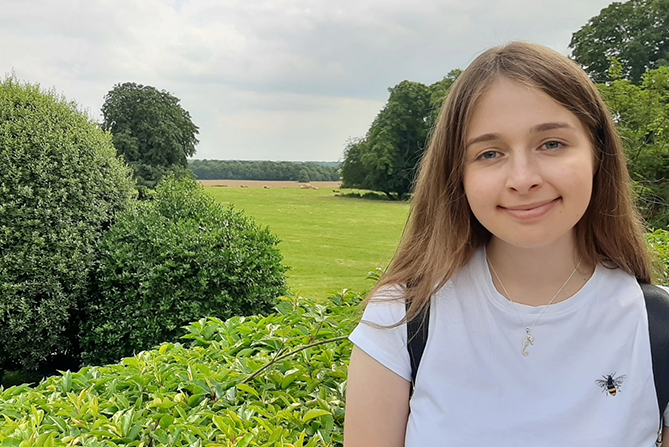
Elena Barham on the ongoing lack of access to the arts for working-class writers.
PEN Transmissions is English PEN’s magazine for international and translated voices. PEN’s members are the backbone of our work, helping us to support international literature, campaign for writers at risk, and advocate for the freedom to write and read. If you are able, please consider becoming an English PEN member and joining our community of over 1,000 readers and writers. Join now.
This piece is in partnership with The Writing Squad, an organisation that exists to create and support the next generation of writers in the north of England. It is part of a year-long series, supported by the Norman Trust, showcasing Gen Z writers and writing. Read our editorial on the series here.
~
On my first poetry residential, after someone had performed, I enthusiastically rubbed my fingers together like Salt Bae. It was a motion I’d observed over the Zoom meetings arranged ahead of the residential. Initially, I’d clapped during these sessions – inaudibly, like a Punch and Judy puppet. When I’d finished hyper-focussing on my own Zoom image, I saw the others doing the Salt Bae routine. I thought it was clever and meaningful – that it meant the performance had been brilliant, that it was seasoned – and I felt cultured.
I’m from a post-industrial working-class town of low-social progression in the North – a lot of ways to say that Barnsley has been consistently underfunded. Growing up, I always wrote, but despite being zealously encouraged by my brilliant mum, the underfunding of the arts in my wider community meant I wasn’t encouraged outside my home. When I was 7, a well-intentioned teacher told me that a boy in my class was much more likely to become a Formula One driver than I was to become a published writer. I didn’t know why she said it, but five years later I was elated to have published my first poem. I’d be well into my teenage years when I’d meet other creatives, let alone feel a part of a network.
‘Why are we finger snapping because of the beatniks?’ I asked when I learned of my error. ‘Why would you sprinkle like Salt Bae?’ came the reply. Both are valid questions. If you didn’t grow up in what often seems a very middle-class literary world, you throw yourself in and adapt. And when you’re the first in your family to pursue a creative career, you rely on your own cultural cues; you sprinkle like Salt Bae.
Of course, there are times when this isn’t possible. Only two years ago, I attended the start of a series of Zoom playwrighting workshops aimed at those from the North that met a working-class criteria and was described as being led by working-class creatives. During the session, the director of the company suggested starting with icebreakers, ‘I know, let’s all say what the first play we remember seeing was – and please don’t count amateur dramatics or musicals!’ He shared his own earliest experience – going to see Hamlet while at prep school. I had never seen a professional play.
If I’d been younger, I’d have stayed on and lied. Instead, I realised that this wasn’t the type of course from which I’d derive value. If I were to attend a session like this now, I’d like to think I would’ve stated one of the many amateur dramatic productions I’d seen and loved. There’s a peculiar joy to amateur dramatics – to watching of a diverse group of people, managing jobs and families, create something of no financial benefit to themselves but for sheer passion. Yes, you might see someone in the wings meant to be unseen, an accidental foot poked out, but that does not devoid the production of artistic merit. I probably wouldn’t say all that; I’d feel pretentious. It would be too obvious that I was once a perpetrator of amateur dramatics. I guess elitism runs deep.
I recently saw The Seagull for the first time. It features a widely celebrated author, Trigorin, who feels his success is an elaborate prank and that he is only good at writing nature descriptions. Every writer experiences impostor syndrome at times, but if you’re from a working-class background this can be an overwhelming feeling. ‘But that was awful,’ you often think, as someone compliments a recently published piece of yours. ‘Did anyone else enter this nationally advertised competition I won?’ you wonder. ‘What if me being accepted onto this course was part of a new Channel 4 social experiment,’ you think. I think wherever Trigorin was from must have been a little bit like Barnsley.
You’d think technology would erode some of these barriers. And this has happened to an extent. With online meetings, freelancers no longer have to travel to London for interviews, saving time and travel fees that are often overlooked in the industry. Conducting writing programmes in such a manner mean that participants can be readily recruited from across the country. There’s no doubt that online courses and opportunities have improved access within the industry, and that I’ve greatly benefitted from it. But as I’ve met other writers who’ve been accessing events for the majority of their lives, I feel strongly that the internet alone cannot bridge the gap.
To create a country where the arts are valued, there must be engagement at a regional level. Accessible online events are – so far – mostly aimed at adults. How can a working-class child hope to become a writer if they simply don’t have access to literary communities? It’s obviously not impossible, and I know this first-hand. But it’s still improbable. In my late teenage years, I knew several working-class writers my age from the same region who were exceptionally talented, despite a lack of creative opportunities. Yes, people change as they age, but how can it be that none of them write now, neither professionally nor personally? Sadly, I understand why.
For a level playing field, we need the normalisation of the arts in places like Barnsley. The idea that working-class people are uniformly uninterested in the arts is so casually ingrained in the class system. While calls to fund the arts in working-class areas grow ever louder, there’s still a pervading rhetoric that the arts are not wanted or, worse, needed by the people who live there, that they are in fact hostilely opposed. On several occasions, including in an interview for a commission, I’ve been told that, coming from my hometown, I’ve done well to have achieved the things I have. This is always meant to be complimentary, I know this, but when people compliment me in this way, I wonder what exactly they think happens in working-class towns and cities. Poets shot on sight. Novelists exiled from Barnsley, a town that has produced several notable writers.
To fund the arts is to create the next generation of artists. To fund it in these particularly overlooked areas is to create writers with new stories to tell. When I was a teenager, I was captivated by the kitchen-sink realist writers of the 60s, the so-dubbed angry young men. I loved how their writing still seemed so fresh, so daring – unlike much of the work produced by their upper-class counterparts. Could you imagine a working-class literary revolution happening today? I think it could. Just as a novel is improved by variety, so is the literary industry. Why shouldn’t the Beatnik snappers and Salt Bae sprinklers coexist?
Elena Barham writes prose, poetry and plays and lives in Barnsley with her two cats. She is the 2022 winner of the BBC Young Writers’ Award with her short story Little Acorns and the 2021 winner of Ilkley Literature Festival Young People’s Poetry Prize. Last year she was delighted to be included in the Northern Dreaming anthology by the British Library as part of LEEDS 2023 – a project by working-class creatives aimed to empower working-class children. Alongside studying for her English Literature degree, she is a correspondent for arts, theatre and culture for Forge Press and has recently written her first film screenplay.
Photo credit: Elena Barham



 PEN Transmissions