

Chloe Gong on how YA fiction and Shakespeare shaped her writing voice.
PEN Transmissions is English PEN’s magazine for international and translated voices. PEN’s members are the backbone of our work, helping us to support international literature, campaign for writers at risk, and advocate for the freedom to write and read. If you are able, please consider becoming an English PEN member and joining our community of over 1,000 readers and writers. Join now.
This piece is part of a year-long series, supported by the Norman Trust, showcasing Gen Z writers and writing. Read our editorial on the series here.
~
Chloe – thank you so much for speaking with me. I wanted to start by asking about your writing practice. You’ve been writing for almost half your life. What first ignited your craft? And what tools have helped you sustain it?
Thank you for having me – I’m so happy to be here chatting. I started writing because I was a big reader. I was a huge fan of the franchises that were erupting in the 2010s during the dystopian and paranormal romance era. When I ran out of books to read from my borrowed library stack every week, I essentially had ran out of hobbies. My whole teenage life revolved around books; if I wasn’t reading, I was thinking about reading, or probably talking about it on Tumblr. What I loved most was the escapism. To fill the void once I had finished my library books, I turned to writing my own. As the years went on – and I picked up more hobbies and interests – escapism evolved into a love for storytelling. It felt wonderful to create a whole world that would feel real to a reader – as real as my favorite books felt to me. I have to remember that I’m creating something out of nothing, and it shouldn’t be like sitting down to write a to-do list – reframing the work as “not work” is a tool that helps keep the creativity running.
Your books take inspiration from Shakespeare, but as someone who has raised reading YA fantasy, I can see the influence of the likes of Cassandra Clare’s Mortal Instruments series on your books too. What made you gravitate towards blending Shakespeare and YA? And how has reimagining work like Romeo and Juliet and As You Like It changed how you see the originals?
When I first began reading, books like The Mortal Instruments, Divergent, Daughter of Smoke and Bone, The Raven Cycle and so on were huge influences for my love of storytelling. I was 14 – these were the books that were made for me! This was also the background I’d come from when I started writing These Violent Delights several years later; though I’d started reading adult fiction, non-fiction, classics, I was still most familiar with YA, and so that’s what I wanted to write. I do sometimes wonder how much of Jace Herondale’s sardonic influence bleeds into every love interest I’ll ever write.
The Shakespearean angle was something I stumbled into. The original pitch for These Violent Delights had been: ‘Two rival gangs in a blood feud are forced to put aside the bloodshed when a monster rises and starts killing all their people’. And since there would be some sort of romantic storyline between the two enemy children, there was no way someone would hear that and not think ‘Oh, Romeo and Juliet’. I chose to embrace the similarities and offer a new lens on the story. I kept running with it, adapting As You Like It for Foul Lady Fortune. It’s given me a new appreciation for the originals, because I needed to decide what I thought the backbone of the play was; what it was specifically for me. Only then could I faithfully hold the heart of it and change out what I didn’t need.
You have written two relatively standalone series that exist in the same Secret Shanghai universe. Your worldbuilding is consummate, while also critiquing established ideas about fantasy and interrogating the genre’s colonial baggage. With all this in mind, how did writing within an existing universe free or hinder your writing?
Initially, there was a lot of pressure in writing a spin-off, because it had to be both similar enough to justify being set in the same world, and different enough to warrant being a new series rather than a continuation. My approach was to write These Violent Delights and Foul Lady Fortune in two different genres; though they share some of the same cast, These Violent Delights is historical fantasy while Foul Lady Fortune is more of a noir spy thriller. Between the 1920s and 1930s, Shanghai underwent enormous change, and the feeling I was trying to evoke when portraying the two decades is different. Historical fantasy, with a monster rising from the river, was most fitting for These Violent Delights as it grappled with colonialism in the late 1920s and with the elite’s own role in the destruction of their sense of identity. By the 1930s, we were less concerned with the West and more with impending Japanese imperialism, as well as domestic politics as Shanghai tried to put one unified fighting force forward. As a result, Foul Lady Fortune was full of double-spies and triple-spies, of ‘superpowers’, and of questions of responsibility to your government. I tried not to think of the existing universe as a limit, but more as a framework I could play with depending on what the new series needed.
I’d like to talk a little about BookTok, and the resurgence in fantasy readerships. How do you balance the pressure to write for your audiences with your own artistic priorities?
I try to separate things – to think about audience expectations as something to keep in mind for engagement, and artistic priorities as what dictates the writing process. Of course, there’s bleed over: if I’m thinking about a character’s decisions, I’m also thinking about everything I have read within the genre and what felt satisfying to me as a reader, and I gravitate toward choices that have expected payoffs. It’s nice to lean into elements that readers are passionate about, taking advantage of the romantic tropes that are present, or leading toward plot twists that are guaranteed shockers. But these must exist for the sake of the story before they’re looked at with an eye for marketing, or else the story loses its heart. I’ll never insert anything just for the sake of an audience expectation, but I can make use of what already works for the book I’m trying to write.
What’s next for you?
I’m currently working on my next YA, a cyberpunk trilogy opener called Coldwire. I am forbidden from saying too much until we have an official summary, but it is set in a near future world where life has moved to virtual reality. It has corporate soldiers waking up to the system, mega-corporations trying to take over the world, anarchists and hackers, etc. It’s everything I loved during the dystopian era, but written for a new tech-driven generation. And I’m so excited about it!
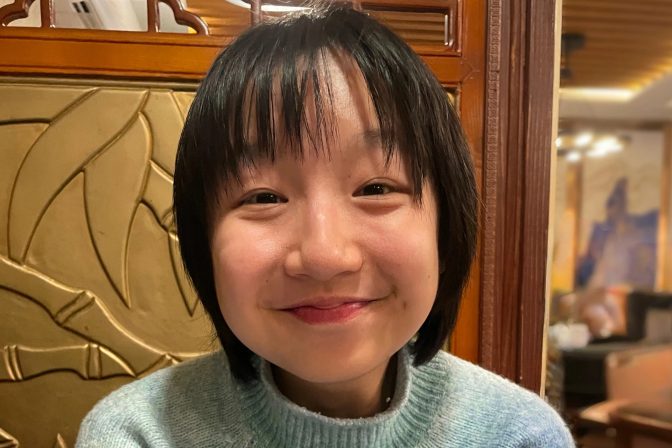
Chloe Gong is the #1 New York Times bestselling author of the critically acclaimed Secret Shanghai novels, as well as the Flesh and False Gods trilogy. Her books have been published in over twenty countries and have been featured in The New York Times, PEOPLE, Cosmopolitan, and more. She was named one of Forbes’ 30 Under 30 for 2024. Chloe graduated from the University of Pennsylvania with a degree in English and International Relations. Born in Shanghai and raised in Auckland, New Zealand, she is now located in New York City, pretending to be a real adult. Visit her online at thechloegong.com and on Instagram, X, and TikTok at @thechloegong.
Photo credit: One Grid Studio

 PEN Transmissions